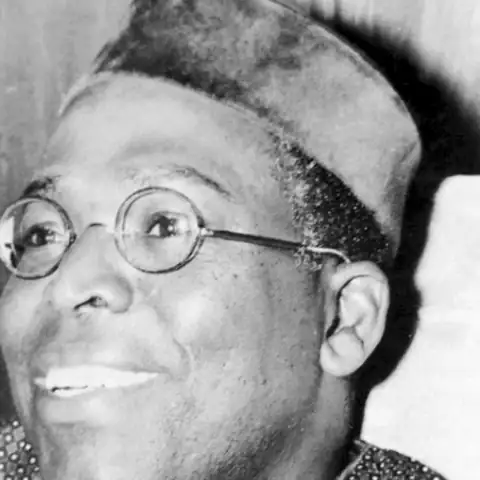
Who was Obafemi Awolowo?
Obafemi Awolowo trained as a lawyer in London and became one of Nigeria's best-known nationalists. He co-founded the Action Group, which was inaugurated on 28 April 1951, and became its first president. From 1954 he headed the government of the Western Region, where his party began free primary education and free health care for children. After the 1962 Western Region crisis he was convicted of plotting to overthrow the federal government and was jailed for ten years from 1963. He was pardoned in 1966, served as federal finance commissioner during the civil war and founded the Unity Party of Nigeria. He died on 9 May 1987.
Political views
- Founded the Action Group in 1951 and co-founded the Nigerian Tribune, which became the party's newspaper.Source: blerf.org
- Argued in Path to Nigerian Freedom (1947) that federalism was the only basis for equitable national integration.Source: businessday.ng
- His Western Region government introduced what the article calls the first free primary education program in Africa, and a free medical service for children up to 18.Source: vanguardngr.com
- Brought in Nigeria's first minimum wage policy and promoted about 900 cooperative societies in roughly three years.Source: vanguardngr.com
- Is described as a leading social democratic politician who backed limited public ownership and limited central planning. His Unity Party followed democratic socialist lines.Source: businessday.ng
- His government built the Ikeja industrial complex, Cocoa House and what the article calls Africa's first television station.Source: businessday.ng
- Was convicted of plotting to overthrow the federal government and sentenced to ten years in 1963, then pardoned in August 1966.Source: blerf.org
- As federal finance commissioner from 1967 to 1971 he helped pay for the war against secession without foreign loans, and he lost the 1979 and 1983 presidential elections.Source: businessday.ng
Legacy
Admirers see Awolowo as the great planner of Nigerian politics, whose free schooling and health policies reached poor families and set a model that other regions copied. He is also credited with building a modern regional administration. Critics point to the Yoruba cultural movement he co-founded in 1949 and say his party stayed rooted in one ethnic region, so he never gained a national majority. The 1962 crisis in the West brought widespread violence, and he was convicted of treason felony. His supporters saw the case as political, while opponents saw a plot against the federal government. He lost the 1979 and 1983 presidential elections.