12axes-testTake the test
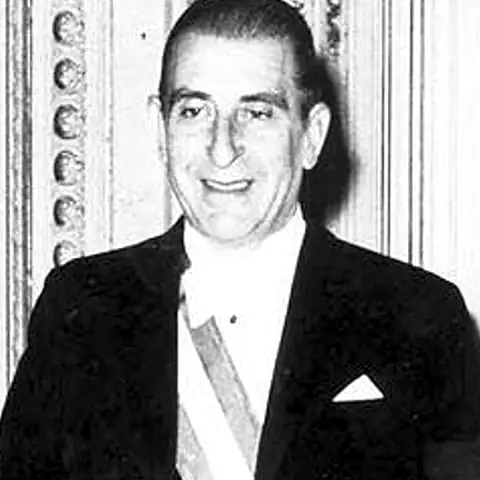
Eduardo Frei Montalva
Historical figureChile1911-1982

Eduardo Frei Montalva

President of Chile (1964-1970) · Leader of the Christian Democratic Party

Chilean Christian Democrat who won the presidency in 1964 on a promise of Revolution in Liberty, pursued agrarian reform and a partial copper takeover, then became a critic of Pinochet.

Profile on 12 axes6 of 12 documented
ECONOMYSTATESOCIETYWORLDOwnershipMarketsWelfareAuthoritySecurityStructureMoralityReligionTechnologyCultureTradeForeign
Where they stood

Eduardo Frei Montalva, axis by axis

  1. PublicPrivate

    His government bought 51 percent of the big copper mines and expropriated large farms. He still wanted a mixed economy that opposed both Marxism and unregulated capitalism, so only mildly toward public ownership.

  2. PlannedFree
  3. SharedSelf-reliant
  4. DemocraticStrong leader

    He ran Chile through elections and called his program a revolution within liberty and law. But he first welcomed the 1973 coup and only later turned against Pinochet, so the score is moderate, not strong.

  5. LibertyOrder

    His early backing for the military takeover points slightly toward order, while his later criticism of the junta over human rights points back. Near the middle.

  6. 06StructureNo clear record
    LocalCentral
  7. 07MoralityNo clear record
    ProgressiveTraditional
  8. 08ReligionNo clear record
    SecularReligious
  9. 09TechnologyNo clear record
    EmbraceCaution
  10. 10CultureNo clear record
    MulticulturalNational identity
  11. 11TradeNo clear record
    GlobalProtected
  12. CooperationStrength

    He joined the North-South Commission in 1977 and wrote on Latin American hope and options. Yet the CIA reportedly funded his 1964 campaign and he was a firm anti-Marxist. Mildly toward cooperation.

6 axes have no clear record, so matching leaves them out.

Who was Eduardo Frei Montalva?

Eduardo Frei Montalva, a Santiago lawyer, left Chile's Conservative party and helped turn its youth wing into the National Falange, a reformist Catholic movement. In 1957 it merged into the Christian Democratic Party. He placed third in the 1958 presidential race, then beat Salvador Allende with an absolute majority in 1964. As president from 1964 to 1970 he promised a revolution within liberty and law. He was elected senator in 1973 and presided over the Senate until the coup. He died in Santiago on 22 January 1982, a few days after his 71st birthday.

Political views

  • Led a party that opposed both Marxism and unregulated capitalism, placing himself in the reformist Catholic centre.Source: encyclopedia.com
  • Helped found the Christian Democratic Party in 1957, built on Christian humanism and the idea of a communitarian society.Source: bcn.cl
  • Promised agrarian reform, an end to inflation, Chilean control of copper, more schools and housing, and wider participation in economic and political life.Source: encyclopedia.com
  • Signed the 1967 agrarian reform law, Ley 16.640, which allowed faster expropriation of large estates. The state set up settlements under the CORA agency.Source: bcn.cl
  • Chileanized copper in 1966: the state gradually bought 51 percent of El Teniente, Andina and Exotica, which US firms had owned.Source: bcn.cl
  • Backed rural unions through Law 16.625 of 1967 and doubled school enrolment, with basic schooling extended from six to eight years and about 130,000 low-cost homes built.Source: bcn.cl
  • Initially welcomed the 1973 military coup, at least until 1975. He then moved into open opposition and led the failed 1978 campaign against Pinochet's plebiscite.Source: encyclopedia.com
  • Published books on the military regime's future and on Latin American hope and options, and sat on the North-South Commission in 1977.Source: bcn.cl

Legacy

Admirers credit Frei with building new schools, housing and rural unions and with giving Chile a democratic alternative to both Marxism and the old right. Critics on the left said his reforms were too timid, while landowners and conservatives said they went too far. Agrarian reform gave land to only a small number of peasants by 1970. A 1973 US Senate subcommittee disclosed that the CIA had funneled $20 million into his 1964 campaign. His early support for the coup cost him credibility with many Chileans. In 2023 Chile's Supreme Court finally ruled that he was not poisoned in 1982.

How close are you to Eduardo Frei Montalva?

Take the 12 Axes test and see which historical figure is your political twin, axis by axis.

Take the test

Eduardo Frei Montalva: questions

What was Revolution in Liberty?

It was Frei's 1964 program: agrarian reform, Chilean control of copper, more schools and housing, and broader participation, all pursued through elections and law rather than through Marxist revolution.

Did Eduardo Frei support the 1973 coup?

At first, yes. Chilean sources say he was favorable to the military intervention at least until 1975. He later became a critic of Pinochet and led the campaign against the 1978 plebiscite.

Was Eduardo Frei a socialist?

No. He led the Christian Democrats, who opposed Marxism and unregulated capitalism alike. His government did buy a majority of the copper mines and expropriate large estates.

Sources

Portrait: FreiMontalva.jpg by Unknown author, CC BY-SA 3.0, via Wikimedia Commons. Cropped and converted to grayscale by 12axes-test.com.