12axes-testTake the test
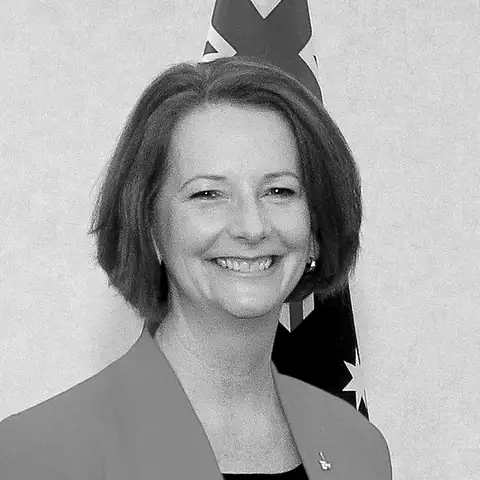
Julia Gillard
Retired figureAustraliaBorn 1961

Julia Gillard

27th Prime Minister of Australia (2010-2013) · Leader of the Australian Labor Party (2010-2013)

Labor leader and Australia's first female prime minister, who led a minority government through a carbon price, a national disability scheme and school funding reform, and who revived offshore processing.

Profile on 12 axes10 of 12 documented
ECONOMYSTATESOCIETYWORLDOwnershipMarketsWelfareAuthoritySecurityStructureMoralityReligionTechnologyCultureTradeForeign
Where they stand

Julia Gillard, axis by axis

  1. PublicPrivate
  2. PlannedFree

    She brought in a carbon price and a mining profits tax, but she also promised business tax cuts and a surplus, so the score leans only moderately toward regulation.

  3. SharedSelf-reliant
  4. DemocraticStrong leader
  5. LibertyOrder
  6. LocalCentral
  7. ProgressiveTraditional

    She spoke out forcefully against sexism, yet she personally opposed same-sex marriage while Labor MPs were given a conscience vote, so the score is mildly progressive.

  8. SecularReligious

    She is an atheist who said she respected religious belief, so the score is mildly secular.

  9. 09TechnologyNo clear record
    EmbraceCaution
  10. MulticulturalNational identity

    Her turn back to offshore processing on Nauru and Manus Island came inside a mostly multicultural Labor tradition, so the score sits a little under the middle.

  11. 11TradeNo clear record
    GlobalProtected

    The sources used show no steady record on tariffs or trade deals, so this is null.

  12. CooperationStrength

2 axes have no clear record, so matching leaves them out.

Who is Julia Gillard?

Gillard, a Labor politician, was born in 1961 in Barry, Wales, and grew up in Adelaide after her family emigrated in 1966. Before politics she practised as an industrial lawyer. She won the Victorian seat of Lalor in 1998 and was made deputy prime minister when Labor won office in 2007. In June 2010 she replaced Kevin Rudd as leader and prime minister. The election that year left parliament hung, so her government depended on the Greens and independents. Rudd took the leadership back in June 2013, and she left politics. She has since taken chair roles with education and health bodies.

Political views

  • She said she had always believed that hard work and education can change lives.Source: moadoph.gov.au
  • She stood up for Labor's Fair Work system and warned that WorkChoices must not return.Source: moadoph.gov.au
  • She pledged to return the budget to surplus, paying for new spending with savings elsewhere.Source: moadoph.gov.au
  • After first ruling out a carbon tax, she brought in a carbon price under the Clean Energy Act 2011, along with a tax on mining profits.Source: en.wikipedia.org
  • Her government launched the NDIS, a national disability insurance scheme, and the Gonski reforms to how schools are funded.Source: en.wikipedia.org
  • In 2012 she brought back processing of asylum seekers offshore, at Nauru and on Manus Island.Source: en.wikipedia.org
  • Her government published the Asian Century White Paper and won a seat on the UN Security Council.Source: en.wikipedia.org

Legacy

Supporters say a minority parliament still produced the NDIS, school funding tied to need and a carbon price, along with the early building of the National Broadband Network. Her 2012 speech calling out the Opposition Leader over misogyny was noticed around the world. Political experts rate her more highly now than when she left office, often placing her in the middle to upper group of prime ministers. Critics say she broke a promise not to bring in a carbon tax and did not deliver the surplus she had pledged. They add that the leadership struggle with Rudd, and scandals involving others such as the Health Services Union affair, dogged her government. Refugee advocates objected to her turn back to offshore processing and to the Malaysia swap deal that fell through.

In their own words

“All of my life I have believed in the transformative power of education.”
Federal election campaign launch, 2010

How close are you to Julia Gillard?

Take the 12 Axes test and see which historical figure is your political twin, axis by axis.

Take the test

Julia Gillard: questions

Is Julia Gillard in the Labor Party?

Yes. She belongs to the Australian Labor Party. She led it from 2010 to 2013 and was prime minister of a minority government after the election of 2010.

What did Gillard say in the misogyny speech?

In October 2012 she rose in parliament and accused Tony Abbott, then Opposition Leader, of sexism and misogyny, reading out remarks she said backed her case. The speech was shared widely around the world.

Did Gillard break a promise on the carbon tax?

She had ruled out a carbon tax earlier, then brought in a carbon price under the Clean Energy Act of 2011. Critics say that broke her pledge.

Sources

Portrait: Julia Gillard.jpg by Dilma Rousseff, CC BY-SA 2.0, via Wikimedia Commons. Cropped and converted to grayscale by 12axes-test.com.