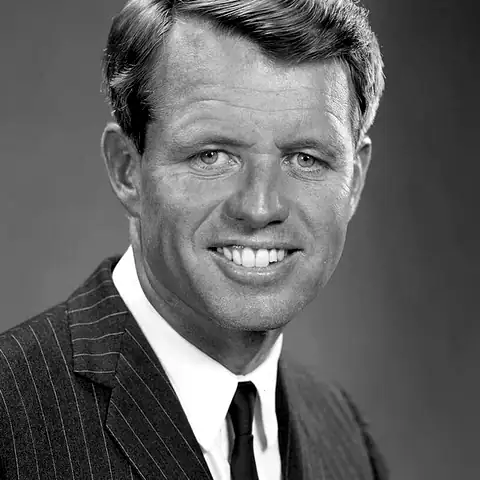
Who was Robert F. Kennedy?
Robert F. Kennedy trained as a lawyer and served in the Navy. He first won attention as a Senate investigator of union corruption, and in 1960 he ran his brother John F. Kennedy's presidential campaign. From 1961 to 1964 he was attorney general. In that job he led the federal fight against organized crime, handled the civil rights crisis and advised the president closely during the Cuban Missile Crisis. New York voters sent him to the Senate in 1964. In the Senate he broke with US policy in Vietnam and spoke on poverty and race. In 1968 he sought the Democratic nomination. Right after winning the California primary he was shot in Los Angeles, and he died the next day.
Political views
- He urged a stop to US bombing in the north of Vietnam, and by 1967 he was calling the war immoral.Source: en.wikipedia.org
- He built the first coordinated federal drive against organized crime and pursued the Teamsters leader Jimmy Hoffa, who was found guilty in 1964.Source: en.wikipedia.org
- He sent federal marshals so that James Meredith could enroll at the University of Mississippi, and he worked to get the 1964 Civil Rights Act through Congress.Source: en.wikipedia.org
- He set up the Bedford Stuyvesant Restoration Corporation to bring better housing and work to a poor Brooklyn area.Source: rfkhumanrights.org
- He stood with Cesar Chavez's striking farmworkers, and on a 1966 trip to South Africa he spoke out against apartheid.Source: en.wikipedia.org
- In the Cuban Missile Crisis he helped shape the naval blockade plan and met in secret with the Soviet ambassador to help end it.Source: en.wikipedia.org
- He co-sponsored a 1965 bill to limit sales of guns by mail, which pointed the way to the Gun Control Act of 1968.Source: en.wikipedia.org
Legacy
Admirers say Kennedy changed from a hard-nosed political operator into a spokesman for the poor, Black Americans, farm laborers and war protesters. His 1968 campaign drew supporters of every race and class. Some historians rank him as one of the best attorneys general. Critics bring up his early job on Senator Joseph McCarthy's staff, his reputation for ruthlessness, his role in covert action against Cuba and his sign-off on FBI taps of Martin Luther King Jr.'s phones. He died at 42, so people still wonder what kind of president he would have made.
In their own words
“What we need in the United States is not division; what we need in the United States is not hatred; what we need in the United States is not violence or lawlessness, but is love and wisdom, and compassion toward one another, and a feeling of justice towards those who still suffer within our country, whether they be white or whether they be black.”