12axes-testTake the test
Manmohan Singh
Historical figureIndia1932-2024

Manmohan Singh

14th Prime Minister of India (2004-2014) · Finance Minister of India (1991-1996)

Singh was an economist who opened India's economy as finance minister in 1991, then spent ten years as prime minister, pairing fast growth with new legal rights to welfare.

Profile on 12 axes10 of 12 documented
ECONOMYSTATESOCIETYWORLDOwnershipMarketsWelfareAuthoritySecurityStructureMoralityReligionTechnologyCultureTradeForeign
Where they stood

Manmohan Singh, axis by axis

  1. PublicPrivate

    As finance minister he sold some state firms, but the economy stayed mixed. The score leans mildly private.

  2. PlannedFree
  3. SharedSelf-reliant

    He mixed market reforms with welfare laws built on legal rights, including the rural jobs guarantee and a right to schooling. That points toward shared provision.

  4. DemocraticStrong leader
  5. LibertyOrder
  6. 06StructureNo clear record
    LocalCentral

    No clear stance on central versus devolved power is documented, so this axis is left empty.

  7. 07MoralityNo clear record
    ProgressiveTraditional
  8. SecularReligious
  9. EmbraceCaution
  10. MulticulturalNational identity
  11. GlobalProtected

    He cut import tariffs, let the rupee fall in value and let foreign money into India. His early scholarly work also criticized closed-door trade policy.

  12. CooperationStrength

    His approach was practical engagement, including talks with Pakistan and the nuclear deal with the US. The score leans toward cooperation.

2 axes have no clear record, so matching leaves them out.

Who was Manmohan Singh?

A village in Punjab, then part of British India and now in Pakistan, was where Manmohan Singh was born in 1932. His economics degrees came from Panjab University, Cambridge and Oxford. He later taught, advised the government and ran the Reserve Bank of India. In 1991 India faced a foreign currency crisis, and he was made finance minister. He launched sweeping economic reforms. Sonia Gandhi turned down the top job in 2004, and Singh became prime minister, winning again in 2009. He was the country's first Sikh prime minister and served until 2014. He died in December 2024.

Political views

  • In 1991 he lowered taxes, let the rupee lose value, sold some state-run companies and invited foreign investors in.Source: bbc.com
  • He argued for growth that includes the poor, and his governments passed laws giving people legal rights to food, schooling, work and information.Source: inc.in
  • He brought in a rural jobs scheme that promised at least 100 days of work, and he started the Aadhaar ID project as a way to deliver welfare.Source: bbc.com
  • Early in his career he wrote an academic critique of India's inward-looking trade policy.Source: pmindia.gov.in
  • His 2008 nuclear agreement with the US, covering civilian use, ended India's isolation on nuclear matters. The Left Front withdrew its backing from his government over it.Source: bbc.com
  • He kept the peace process with Pakistan alive and tried to resolve the border row with China.Source: bbc.com
  • In 2005 he apologized in parliament for the anti-Sikh riots of 1984, describing them as a negation of the idea of nationhood in the constitution.Source: bbc.com

Legacy

Admirers say Singh pulled India back from bankruptcy in 1991 and led a decade in which it became one of the fastest-growing big economies. He was widely admired for his honesty and modest manner, and the BBC says his reforms helped lift millions out of poverty. Some critics, though, called him a weak prime minister who took orders from Sonia Gandhi, and they point to corruption scandals in his second term, including the coal licence affair, and to a government that seemed frozen. Singh himself hoped history would judge him more kindly than the media of his day did.

In their own words

“No power on earth can stop an idea whose time has come. I suggest to this august House that the emergence of India as a major economic power in the world happens to be one such idea.”
Budget speech to the Lok Sabha, July 1991

How close are you to Manmohan Singh?

Take the 12 Axes test and see which historical figure is your political twin, axis by axis.

Take the test

Manmohan Singh: questions

Which party did Manmohan Singh belong to?

Congress was his party. He entered the Rajya Sabha in 1991 and, from 2004 to 2014, headed the coalition government that Congress led.

What did the 1991 reforms change in India?

India was short of foreign currency, so Singh devalued the rupee, lowered import duties and taxes, sold some state companies and welcomed foreign investment. Much of the old planned-economy system was dismantled.

Was Manmohan Singh on the left or the right?

Most observers place him in the center. He opened markets and trade, yet as prime minister he also widened welfare rights, including guaranteed rural work and free schooling.

Sources

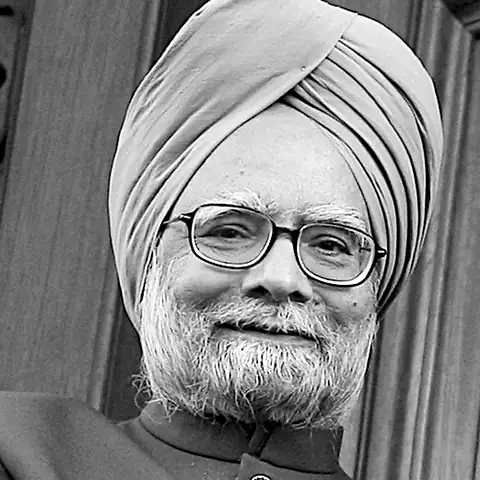
Portrait: IBSA-leaders Manmohan Singh.jpg by Ricardo Stuckert, CC BY 3.0 br, via Wikimedia Commons. Cropped and converted to grayscale by 12axes-test.com.