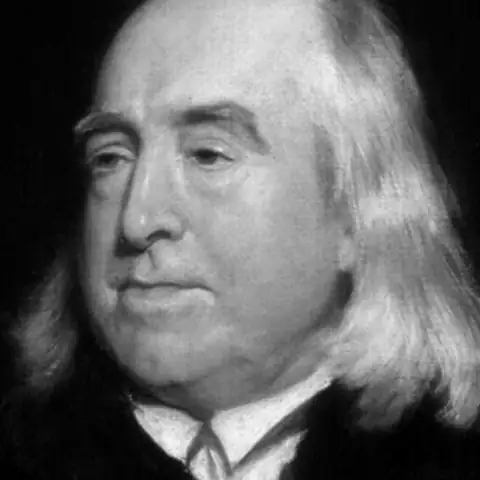
Who was Jeremy Bentham?
Jeremy Bentham was a Londoner who studied law but chose to spend his life trying to rebuild it. In his books on government and on morals and legislation, he argued that only pleasure and pain count as good or bad, so laws should be tested by their effect on happiness. In 1792 revolutionary France made him an honorary citizen for his reform ideas. Over his long life he drafted law codes and constitutions, designed the Panopticon prison and drew a circle of reformers around him. Money from his estate helped found University College London.
Political views
- Taught that every law and public policy should be judged by the principle of utility, meaning its effect on pleasure and pain.Source: econlib.org
- Called natural rights nonsense, and held that rights only exist when the law creates them.Source: iep.utm.edu
- Called for votes for many more people, yearly elections and a secret ballot to guard against abuse of power, and in later life he became a republican.Source: plato.stanford.edu
- Opposed punishing private sexual acts between consenting people, and called for laws against cruelty to animals.Source: plato.stanford.edu
- In A Defence of Usury he argued that the law should not cap interest rates.Source: plato.stanford.edu
- Urged in Emancipate Your Colonies! that empires let their colonies go, and suggested an international court to settle disputes and help keep peace.Source: plato.stanford.edu
- Criticized the established Church and the way religion shaped public life.Source: plato.stanford.edu
Legacy
Bentham's utilitarianism shaped British reform in the 1800s, from law and prisons to the vote, and it influenced John Stuart Mill and later legal thinkers. Admirers credit him with early arguments for sexual freedom, animal welfare and accountable government. Critics, from Germaine de Staël and Benjamin Constant to many later philosophers, said that happiness is too thin a basis for duty and could excuse sacrificing individuals for the sake of the majority. Michel Foucault turned the Panopticon into a symbol of modern surveillance. The 1832 Reform Act and the later secret ballot fit his aims, though historians disagree over how much he personally caused them.
In their own words
“Nature has placed mankind under the governance of two sovereign masters, pain and pleasure.”