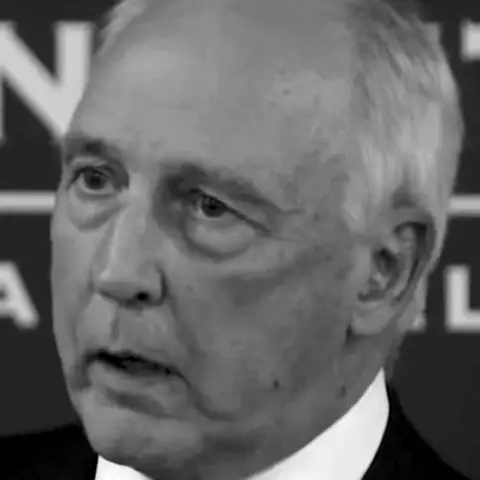
Who is Paul Keating?
Sydney-born in 1944, Keating quit school at 14 and joined the Labor Party. He entered parliament for Blaxland in 1969 at 25. When Bob Hawke formed his government in 1983, Keating became treasurer and drove much of its economic program. He ousted Hawke in December 1991 to become prime minister. He won again in 1993, defying forecasts, but lost heavily to John Howard in 1996. He has since commented publicly, above all on foreign policy.
Political views
- In the Treasury he oversaw floating the dollar, taking down tariff walls and freeing the banks from tight regulation.Source: en.wikipedia.org
- In 1993 he set Australia's record of fairness and equity against what he called the economic and social jungle of Reaganism and Thatcherism.Source: moadoph.gov.au
- Defended Medicare, the safety net and the union Accord as tools for coping with economic upheaval.Source: moadoph.gov.au
- Introduced employer-funded superannuation for all workers, alongside an age pension that is means-tested.Source: en.wikipedia.org
- Promised to confront centuries of wrongs done to Indigenous Australians and to finish the work of reconciliation.Source: moadoph.gov.au
- Wanted a referendum on whether Australia should become a republic with its own head of state.Source: moadoph.gov.au
- Looked at the rapidly growing economies of Asia as the country's biggest trading chance.Source: moadoph.gov.au
- In 2023 he described the AUKUS submarine plan as the 'worst deal in all history'.Source: theguardian.com
Legacy
Fans say Keating did more than almost anyone to open Australia's economy in the 1980s, and that he left lasting reforms in superannuation and native title. His Redfern Park speech about colonisation is regarded as a milestone for reconciliation with Aboriginal people, and he is admired for sharp, combative speeches. Critics hold him responsible for the early 1990s recession, which he described as the recession Australia had to have, and point out that mandatory detention for asylum seekers began on his watch. Opinion polls rated him poorly while he was in office. Since he left, both major parties have criticized his pro-China remarks and his AUKUS attacks.
In their own words
“There really never has been a clearer choice, between the Australian traditions of fairness and equity, and the economic and social jungle of Reaganism and Thatcherism which other countries have just abandoned.”