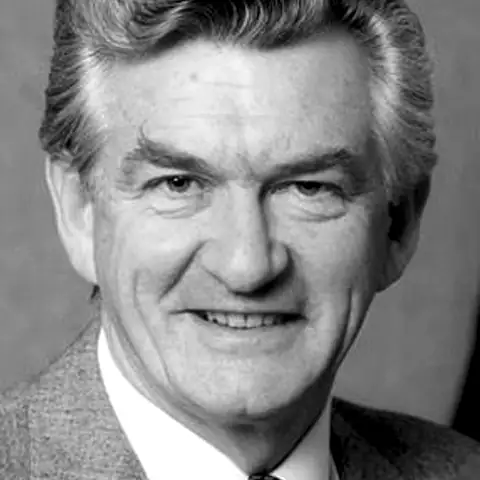
Who was Bob Hawke?
Bob Hawke was born in 1929 in Bordertown, South Australia, to a Congregationalist minister. He won a Rhodes Scholarship to Oxford and rose in the union movement, first as an advocate and then as president of the ACTU. He entered parliament in 1980 and became Labor leader in early 1983. Labor won that year, and he took four elections in all, a Labor record. In December 1991 his treasurer beat him in a party vote. Hawke's easygoing, popular image helped his appeal, and he died in 2019.
Political views
- Went to the 1983 election promising national reconciliation, recovery and reconstruction, to be reached by consensus.Source: moadoph.gov.au
- Struck the Accord with unions on prices and incomes, aiming for full employment and rising living standards.Source: moadoph.gov.au
- Let the Australian dollar float, ended exchange controls and let foreign banks in.Source: theguardian.com
- Lowered tariffs and sold state-owned businesses, among them Qantas and the Commonwealth Bank.Source: theguardian.com
- Brought in Medicare, the public health system, and extra help aimed at the most disadvantaged.Source: theguardian.com
- Helped create APEC in 1989. He was also a firm backer of the US alliance and of Israel.Source: theguardian.com
- Proposed regular constitutional conventions, with some elected delegates, to update the constitution by agreement.Source: moadoph.gov.au
- Called the position of Aboriginal Australians, the first Australians, an unresolved conflict that needed attention.Source: moadoph.gov.au
Legacy
Supporters say Hawke opened up the Australian economy, got unions and business working together and created Medicare. He stayed one of the country's best-liked prime ministers. When China crushed protests in 1989 he offered refuge to tens of thousands of Chinese students. Critics on the left say the Accord, along with deregulation and privatisation, weakened unions and Labor's own traditions, and held real wages flat. In 1987 he said no child would live in poverty by 1990, and that promise is often quoted as one he failed to keep. He kept speaking in public life long after leaving office.
In their own words
“The new path for Australia, after the fifth of March 1983, will be national reconciliation, national recovery, national reconstruction.”