12axes-testTake the test
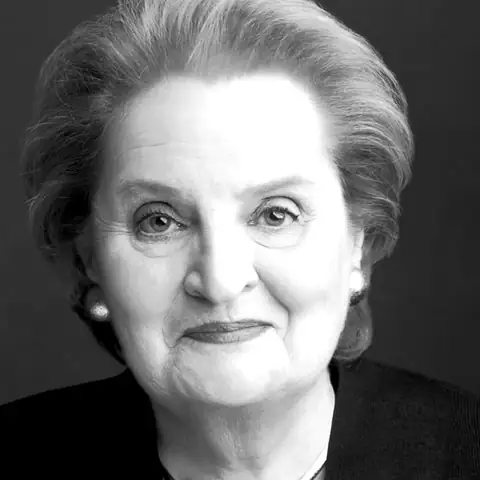
Madeleine Albright
Historical figureUnited States1937-2022

Madeleine Albright

64th US Secretary of State (1997-2001) · US Ambassador to the United Nations (1993-1997)

Czech-born American diplomat who became the first woman to serve as Secretary of State, championed NATO enlargement and intervention in Kosovo, and was later criticized over Iraq sanctions and Rwanda.

Profile on 12 axes6 of 12 documented
ECONOMYSTATESOCIETYWORLDOwnershipMarketsWelfareAuthoritySecurityStructureMoralityReligionTechnologyCultureTradeForeign
Where they stood

Madeleine Albright, axis by axis

  1. PublicPrivate

    Her record supports private enterprise and market-based development abroad.

  2. PlannedFree

    She backed free-market democratization in developing countries as part of Clinton-era policy.

  3. 03WelfareNo clear record
    SharedSelf-reliant
  4. DemocraticStrong leader
  5. 05SecurityNo clear record
    LibertyOrder
  6. 06StructureNo clear record
    LocalCentral
  7. 07MoralityNo clear record
    ProgressiveTraditional
  8. 08ReligionNo clear record
    SecularReligious
  9. 09TechnologyNo clear record
    EmbraceCaution
  10. MulticulturalNational identity

    An immigrant who stressed openness to other cultures and warned against nationalist demagogues.

  11. GlobalProtected

    Her support for market integration and for engagement with former Soviet bloc and developing states points toward open trade.

  12. CooperationStrength

    She was a multilateralist who worked through the UN and NATO, yet she urged force in the Balkans and called the Iraq sanctions price worth it.

6 axes have no clear record, so matching leaves them out.

Who was Madeleine Albright?

Madeleine Albright was born in Prague in 1937. Her family fled to the United States after the communist coup of 1948, and she became a citizen in 1957. After a doctorate at Columbia she worked for Senator Edmund Muskie and on Jimmy Carter's National Security Council, then taught at Georgetown. President Clinton named her US ambassador to the United Nations in 1993 and Secretary of State in 1997, the first woman to hold that post. She served until January 2001 and later ran a strategy firm. She died in March 2022.

Political views

  • Promoted the eastward expansion of NATO into former Soviet bloc countries.Source: history.state.gov
  • Pressed for NATO military intervention in Kosovo in 1999. In a 1993 memo on the Balkans she had argued that only bombing could force the Serbs to negotiate.Source: newrepublic.com
  • Supported free-market democratization and civil societies in the developing world, and favored ratification of the Kyoto Protocol.Source: history.state.gov
  • Said in 1996 that the price of Iraq sanctions was worth it when asked about reported child deaths. In 2004 she called the remark a stupid statement.Source: democracynow.org
  • Named Rwanda as her greatest regret. She objected to instructions to support a full UN withdrawal in 1994 but said she doubted the US could have done much more.Source: pbs.org
  • Said Rwanda shaped her push for early humanitarian action to stop ethnic cleansing in Kosovo.Source: pbs.org
  • In Fascism: A Warning (2018) she cautioned that democracy can erode gradually and warned against leaders who manipulate democratic institutions.Source: georgetown.edu

Legacy

Admirers credit Albright with strengthening ties between the West and the new democracies of Central Europe and with giving American diplomacy a firm moral voice on the Balkans. She received the Presidential Medal of Freedom in 2012. Critics charge that the Iraq sanctions she defended deepened civilian suffering, and her 1996 remark that the price was worth it followed her for life. Others fault the United States, with her at the UN, for failing to stop the 1994 genocide in Rwanda. One reviewer of a biography wrote that she often conformed to Clinton administration positions and was better at stating principles than at turning them into policy.

How close are you to Madeleine Albright?

Take the 12 Axes test and see which historical figure is your political twin, axis by axis.

Take the test

Madeleine Albright: questions

What did Madeleine Albright say about Iraq sanctions?

In a 1996 interview she was asked about reports that half a million Iraqi children had died and replied that the price was worth it. In 2004 she called that a stupid statement and said she regretted it.

Was Madeleine Albright the first female Secretary of State?

Yes. She was confirmed in January 1997 as the 64th Secretary of State under President Clinton, after serving as US ambassador to the United Nations from 1993.

What did Madeleine Albright believe about Rwanda?

She called Rwanda her greatest regret. She said she objected to orders to back a full UN withdrawal in 1994, but doubted a larger intervention would have been approved or changed the outcome.

Sources