12axes-testTake the test
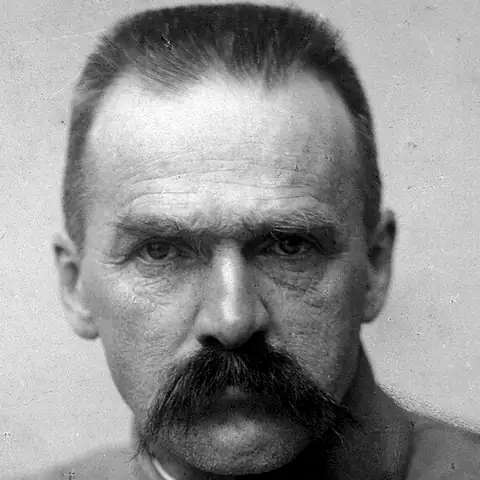
Józef Piłsudski
Historical figurePoland1867-1935

Józef Piłsudski

Chief of State of Poland (1918-1922) · Prime Minister of Poland (1926-1927)

Polish socialist turned independence leader who commanded the Legions, led the state after 1918, beat the Red Army in 1920 and returned by coup in 1926 to run an authoritarian regime until he died.

Profile on 12 axes6 of 12 documented
ECONOMYSTATESOCIETYWORLDOwnershipMarketsWelfareAuthoritySecurityStructureMoralityReligionTechnologyCultureTradeForeign
Where they stood

Józef Piłsudski, axis by axis

  1. PublicPrivate

    He led the Polish Socialist Party in his early career, then put national independence first.

  2. 02MarketsNo clear record
    PlannedFree
  3. 03WelfareNo clear record
    SharedSelf-reliant
  4. DemocraticStrong leader

    He took power in the 1926 coup, controlled parliament through a non-party bloc, arrested opposition leaders in 1930 and left a constitution designed for him personally. Strongly toward strong leadership, though he stayed formally within the state.

  5. LibertyOrder

    A prison for political prisoners at Bereza Kartuska opened in 1934, where some inmates were brutally mistreated. His government answered Ukrainian nationalist terrorism in Galicia with pacification. Toward order.

  6. LocalCentral

    His regime curtailed parliament and parties and ran the state from the center. He favored a federation of peoples abroad, but not local autonomy at home.

  7. 07MoralityNo clear record
    ProgressiveTraditional
  8. 08ReligionNo clear record
    SecularReligious
  9. 09TechnologyNo clear record
    EmbraceCaution
  10. MulticulturalNational identity

    He judged citizens by loyalty to the state rather than nationality, unlike the National Democrats, and Jews gained equal civil rights. But his government also used pacification against Ukrainians in Galicia. Near the middle.

  11. 11TradeNo clear record
    GlobalProtected
  12. CooperationStrength

    He fought the Red Army, backed a Polish-led federation in the east and signed non-aggression pacts with both Moscow and Berlin.

6 axes have no clear record, so matching leaves them out.

Who was Józef Piłsudski?

Józef Piłsudski joined the Polish Socialist Party in 1893 and became a leader in 1895, arguing that socialism and nationalism should work together for independence. In 1914 he formed a force that became the Polish Legions, and he was jailed by the Germans in 1917. After independence in November 1918 he served as Chief of State, and in August 1920 he led the counterattack that stopped the Red Army outside Warsaw. He resigned in 1922, returned by coup in May 1926 and dominated the state as war minister and army chief until he died of liver cancer on 12 May 1935.

Political views

  • Combined socialism with nationalism, arguing it was the best path to Polish independence, and split with his party over armed uprising.Source: newworldencyclopedia.org
  • Wanted a federation of Poland, Lithuania, Ukraine and Belarus as a counterweight to Russia and Germany, and in 1920 allied with Symon Petliura.Source: newworldencyclopedia.org
  • Called the 1921 Treaty of Riga an act of cowardice after Dmowski's National Democrats, who wanted a unitary state, controlled the peace talks.Source: newworldencyclopedia.org
  • Took power in the May 1926 coup, which cost 215 soldiers and 164 civilians their lives, and aimed for a revolution without revolutionary consequences.Source: newworldencyclopedia.org
  • Created a non-party bloc in 1928 to control parliament and in 1930 arrested leading opposition politicians.Source: encyclopedia.com
  • Promised toleration to national minorities, who made up more than a third of the population. Jews gained equal civil rights, while Ukrainian nationalist terrorism in Galicia was met with pacification.Source: encyclopedia.com
  • Steered a middle course between the Soviet Union and Nazi Germany, signing non-aggression pacts with both.Source: encyclopedia.com

Legacy

Poles often honor Piłsudski as the soldier-statesman who restored independence and saved Warsaw in 1920. Admirers add that he moved the state away from the assimilation policy of the National Democrats and that Polish Jews gained equal civil rights. Critics charge that the 1926 coup killed hundreds, that his regime weakened democracy by sidelining parliament and jailing opposition leaders, and that political prisoners were mistreated at Bereza Kartuska. The pacification of Ukrainians in Galicia and a constitution written for him personally drew lasting criticism. After he died the Sanation system fractured, and the regime that followed was discredited by the defeat of 1939.

How close are you to Józef Piłsudski?

Take the 12 Axes test and see which historical figure is your political twin, axis by axis.

Take the test

Józef Piłsudski: questions

Was Piłsudski a dictator?

He seized power in the May 1926 coup and controlled parliament through a non-party bloc and arrested opposition leaders in 1930. His regime is generally described as authoritarian.

Was Piłsudski a socialist?

He joined the Polish Socialist Party in 1893 and led it, but argued that national independence came first. In power he was an authoritarian nationalist, not a socialist.

What was the Intermarium?

Międzymorze was Piłsudski's plan for a Polish-led federation of Poland, Lithuania, Ukraine and Belarus. It was undone by the 1921 Treaty of Riga.

Sources