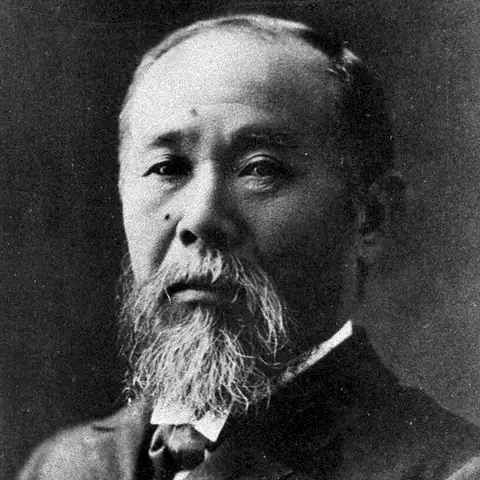
Who was Itō Hirobumi?
Itō Hirobumi was born in 1841 in Chōshū domain, in present-day Yamaguchi. In 1863 he was one of the Chōshū Five sent to study in London. In 1882-1883 he spent about eighteen months in Europe, mainly Germany, studying with constitutional scholars. In 1885 he set up the cabinet system and became Japan's first prime minister, and he held the post four times. He led the drafting of the 1889 constitution, founded the Rikken Seiyūkai party in 1900, and became the first Resident-General of Korea. A Korean activist shot him at Harbin station in October 1909.
Political views
- A trip to London in 1863 convinced him that Japan needed to adopt Western ways.Source: newworldencyclopedia.org
- He studied constitutional law in Germany, and the Meiji Constitution that followed was modeled on the Prussian government.Source: newworldencyclopedia.org
- The constitution was proclaimed in 1889, and a two-chamber Diet met from 1890, with written guarantees of basic rights.Source: newworldencyclopedia.org
- In 1885 he established a cabinet system of government and became the first prime minister.Source: ndl.go.jp
- When two opposition parties rejected his land tax proposal he dissolved the Diet, and in 1900 he organized the Rikken Seiyūkai to give the government a friendly party.Source: newworldencyclopedia.org
- He believed party politicians could not weigh the nation's welfare and destiny without bias.Source: newworldencyclopedia.org
- He became the first Resident-General of Korea on 21 December 1905, after a treaty made Korea a Japanese protectorate, and in 1907 he pressed King Gojong to abdicate.Source: newworldencyclopedia.org
Legacy
Admirers see Itō as the builder of the modern Japanese state: a cabinet system, a constitution with a Diet and written rights, and a government-aligned party that worked with elected politicians. Critics held that the constitution perpetuated authoritarian rule. In Korea he resigned in 1909 having failed to win Korean trust, and a Korean nationalist, An Jung-geun, shot him that October. One account suggests he favored a more even-handed Korea policy than other Japanese leaders.