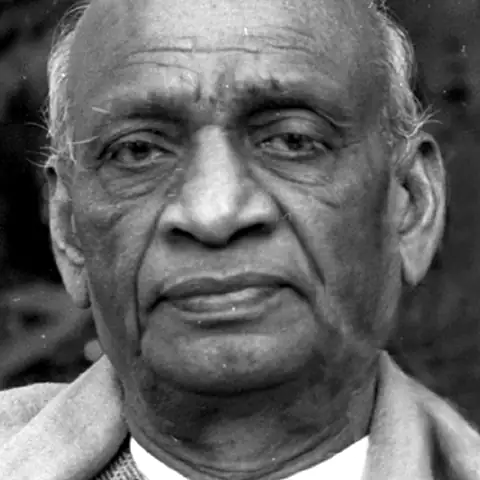
Who was Vallabhbhai Patel?
Vallabhbhai Patel was a Gujarati lawyer who joined Gandhi's movement after meeting him in 1915. He led the 1928 Bardoli land revenue campaign, which earned him the title Sardar, and was elected Congress president in 1931. After independence in 1947 he served as Deputy Prime Minister and Home Minister, and also held the States portfolio. In that role he steered hundreds of princely states into the Indian union, using talks, privy purses and, at Hyderabad in 1948, force. He died of a heart attack in Mumbai on 15 December 1950.
Political views
- Met Gandhi in 1915 but took about two years to accept his nonviolent methods. He then organized a no-tax campaign and led the 1928 Bardoli struggle against a land revenue rise.Source: ebsco.com
- One account calls him one of the earliest proponents of property rights and free enterprise in India, and says he supported the cooperative milk union that came before Amul.Source: newworldencyclopedia.org
- Socialists such as Jaya Prakash Narayan and Asoka Mehta criticized his closeness to industrialists such as the Birla and Sarabhai families.Source: newworldencyclopedia.org
- Accepted partition, arguing that a divided India was better than one held back by Muslim League obstruction.Source: newworldencyclopedia.org
- After the violence of 1947 he visited the Nizamuddin Auliya shrine in Delhi to reassure Muslims, and he worked with Muslim leaders to end separate electorates.Source: newworldencyclopedia.org
- As Home Minister he brought the princely states into the union through persuasion, privy purses and a deadline of 15 August 1947, and ordered the army into Hyderabad in September 1948.Source: vajiramandravi.com
- Chaired the constituent committees on minorities, fundamental rights and provincial constitutions, and helped bring B.R. Ambedkar in as chair of the drafting committee.Source: newworldencyclopedia.org
Legacy
Indians remember Patel as the Iron Man who made a single country out of hundreds of princely states. Admirers also praise his loyalty to Gandhi and his steadiness after partition. Critics argue the integration used coercion, and one historian compares him to Bismarck for his ruthless handling of princely resistance. Maulana Azad and some Hindu nationalists attacked his readiness to accept partition. Some Subhas Bose supporters said he acted high-handedly towards Congress rivals, and socialists thought him too friendly to big business. Some historians say the integration overrode the right of the states to decide for themselves.