12axes-testTake the test
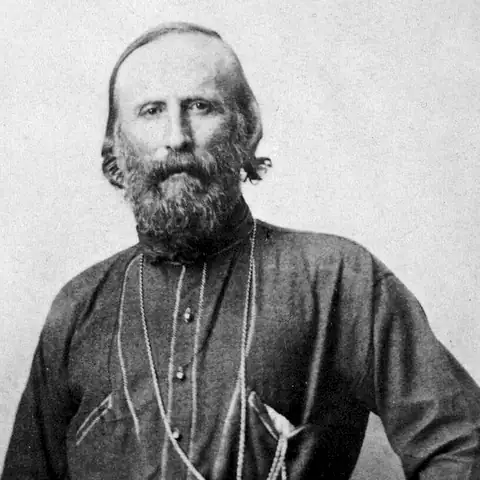
Giuseppe Garibaldi
Historical figureItaly1807-1882

Giuseppe Garibaldi

Leader of the Expedition of the Thousand (1860) · Dictator of Sicily (1860)

Italian general and republican nationalist who led the Expedition of the Thousand in 1860, helped unify Italy under the House of Savoy, and fought the temporal power of the papacy.

Profile on 12 axes6 of 12 documented
ECONOMYSTATESOCIETYWORLDOwnershipMarketsWelfareAuthoritySecurityStructureMoralityReligionTechnologyCultureTradeForeign
Where they stood

Giuseppe Garibaldi, axis by axis

  1. PublicPrivate

    A biographical entry says he defended private property, inheritance and the family while joining the International in 1871, so the score is near the middle.

  2. 02MarketsNo clear record
    PlannedFree
  3. SharedSelf-reliant

    His socialism rested on humanitarian ethics rather than theory, so the welfare score is mild.

  4. DemocraticStrong leader

    He was a republican democrat who also asked for dictatorial powers in 1849 and 1860 and favored temporary dictatorship in crises. The score balances both.

  5. 05SecurityNo clear record
    LibertyOrder
  6. LocalCentral

    He fought for a united Italy and backed the House of Savoy for practical results.

  7. 07MoralityNo clear record
    ProgressiveTraditional
  8. SecularReligious
  9. 09TechnologyNo clear record
    EmbraceCaution
  10. 10CultureNo clear record
    MulticulturalNational identity
  11. 11TradeNo clear record
    GlobalProtected
  12. CooperationStrength

    He led volunteer armies and fought abroad for causes he backed, but he also formed an International Legion and spoke for universal brotherhood.

6 axes have no clear record, so matching leaves them out.

Who was Giuseppe Garibaldi?

Giuseppe Garibaldi was born in Nice in 1807, went to sea young, and joined Mazzini's Young Italy in the 1830s. After a failed uprising he went into exile and fought in Brazil and Uruguay. He returned to defend the Roman Republic in 1849. In 1860 he landed in Sicily with about a thousand volunteers, took the island, and entered Naples on 7 September. He handed his conquests to Victor Emmanuel II. Later efforts to take Rome ended at Aspromonte in 1862 and Mentana in 1867. He fought for France in 1870-1871 and died on Caprera in 1882.

Political views

  • He joined Mazzini's Young Italy in 1833 and fought for the Roman Republic in 1849.Source: treccani.it
  • After 1860 he set aside his republican principles for unification, hailing Victor Emmanuel II as King of Italy at Teano on 26 October 1860.Source: newworldencyclopedia.org
  • On 14 May 1860 he declared himself dictator of Sicily in the king's name, and in later years he argued for temporary dictatorship in crises.Source: treccani.it
  • When offered a major general's post in the Union Army in 1861, he asked that slavery be definitively abolished and that he have full command. The offer was withdrawn.Source: newworldencyclopedia.org
  • He was anticlerical and a freemason, and he sought to end papal rule over Rome, leading failed marches in 1862 and 1867.Source: newworldencyclopedia.org
  • In 1879 the Lega della democrazia program he backed called for abolishing religious orders and for secular, free, compulsory education.Source: treccani.it
  • He joined the International in 1871. His socialism rested on humanitarian ethics, and he defended private property, inheritance and the family.Source: treccani.it

Legacy

Italians honor Garibaldi as one of the heroes of unification, and his volunteers became a symbol of popular nationalism. Admirers credit him with winning the south for the new kingdom and with backing oppressed peoples abroad. Critics note that he claimed dictatorial powers in Sicily and favored dictatorship in crises, disliked parliamentary politics, and left a figure so loose in doctrine that nationalists, Fascists, Socialists and Communists each claimed him. His Roman marches failed, and the papacy lost Rome only in 1870, after the Italian army took it without him.

How close are you to Giuseppe Garibaldi?

Take the 12 Axes test and see which historical figure is your political twin, axis by axis.

Take the test

Giuseppe Garibaldi: questions

Was Garibaldi a republican?

He began as one in Mazzini's Young Italy, but after 1860 he set aside his republican principles to back unification under Victor Emmanuel II.

Was Garibaldi a socialist?

He joined the International in 1871, but a biographical entry says his socialism rested on humanitarian ethics and he defended private property and the family.

Sources