12axes-testTake the test
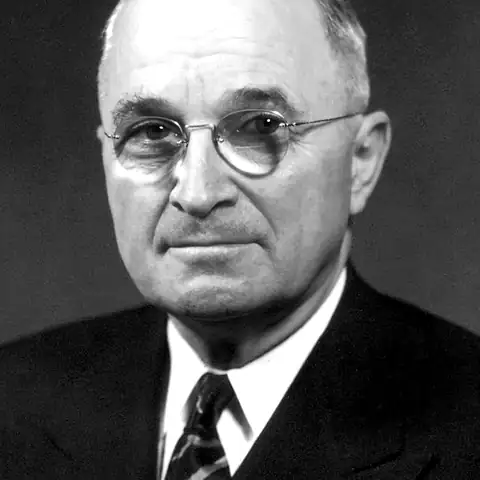
Harry S. Truman
Historical figureUnited States1884-1972

Harry S. Truman

33rd President of the United States (1945-1953) · Vice President of the United States

Missouri Democrat who became president in 1945, used the atomic bomb, built the postwar alliance system, pushed the Fair Deal and ordered the armed forces desegregated.

Profile on 12 axes9 of 12 documented
ECONOMYSTATESOCIETYWORLDOwnershipMarketsWelfareAuthoritySecurityStructureMoralityReligionTechnologyCultureTradeForeign
Where they stood

Harry S. Truman, axis by axis

  1. PublicPrivate

    Suggested more projects like the Tennessee Valley Authority and took over the steel industry in 1952, but he worked inside a private economy.

  2. PlannedFree

    Wanted price controls from the war to continue after 1945, and he vetoed Taft-Hartley's curbs on unions.

  3. SharedSelf-reliant

    The Fair Deal he proposed included health insurance for all, wider Social Security and a better minimum wage.

  4. DemocraticStrong leader

    Took over the steel mills in the Korean War without approval from Congress. The Supreme Court overturned the move in 1952.

  5. LibertyOrder

    Launched the federal loyalty programme against Communists, which he later called a mistake in private. He vetoed the McCarran Internal Security Act too and attacked Senator McCarthy.

  6. LocalCentral

    Urged federal action on civil rights and a larger national part in the economy.

  7. 07MoralityNo clear record
    ProgressiveTraditional

    The sources record no stand on family or social norms. Left blank.

  8. 08ReligionNo clear record
    SecularReligious

    The sources record no plan on religion in public life. Left blank.

  9. 09TechnologyNo clear record
    EmbraceCaution

    The atomic bomb decision is counted under foreign policy. He has no wider technology record here, so this stays blank.

  10. MulticulturalNational identity

    Ended segregation in the armed forces and federal jobs by executive order and asked for looser immigration law.

  11. GlobalProtected

    Turned down a Republican bid for higher wool tariffs as isolationist and kept the reciprocal trade programme going.

  12. CooperationStrength

    Approved the bombing of Japan and sent troops into Korea. He also helped create the UN, the Marshall Plan and NATO. Leans toward strength inside alliances.

3 axes have no clear record, so matching leaves them out.

Who was Harry S. Truman?

Harry Truman grew up on a Missouri farm and commanded an artillery unit in the First World War. His men's clothing store later went broke, and he turned to politics through the Democratic machine in Kansas City. In the Senate he headed a wartime committee that hunted for waste in defence spending. Franklin Roosevelt picked him as vice president in 1944, and he became president on Roosevelt's death in April 1945. Within months he had to bring the war and decide on the atomic bomb. The Cold War began on his watch. He surprised the country by beating Thomas Dewey in 1948. The Korean War and fear of Communist spies darkened his second term, and he chose not to run again in 1952.

Political views

  • The Fair Deal was his plan to add health insurance for all, widen Social Security and lift the minimum wage.Source: millercenter.org
  • He approved the atomic attacks on Hiroshima and Nagasaki in August 1945. Japan surrendered soon after.Source: millercenter.org
  • With Executive Order 9981 in 1948 he told the military to end racial segregation.Source: archives.gov
  • He vetoed the 1947 Taft-Hartley Act, arguing that it took basic rights from workers. Congress passed it over his veto.Source: millercenter.org
  • The Truman Doctrine of 1947 promised help to governments facing Communist pressure. Greece and Turkey were the first.Source: millercenter.org
  • In 1946 he set up a federal loyalty programme to find Communists among government staff.Source: millercenter.org
  • In 1952 he took over the steel industry to head off a strike in wartime. The Supreme Court ruled that he had no power to do so.Source: millercenter.org

Legacy

When Truman left office few Americans liked him. Since then historians have tended to rate him well. They give him credit for the Marshall Plan, NATO and the containment policy, and for pressing civil rights early. On the left, critics say his loyalty programme and harsh language helped feed the McCarthy panic. On the right, they blame him for the deadlock in Korea and for firing General Douglas MacArthur. The atomic bombings killed well over 100,000 people at once, most of them civilians. Supporters say they ended the war and spared Japan an invasion. Opponents say Japan was already near surrender and that attacking cities cannot be justified.

How close are you to Harry S. Truman?

Take the 12 Axes test and see which historical figure is your political twin, axis by axis.

Take the test

Harry S. Truman: questions

Was Harry Truman a Democrat?

Yes. He followed Franklin Roosevelt into the White House in 1945, then won a term of his own in 1948 for the Democrats.

Why did Truman drop the atomic bomb?

His stated aim was to end the war quickly and avoid invading Japan, which was expected to cost many lives on both sides. Historians still argue over whether Japan would have surrendered without the bombs.

What was the Fair Deal?

It was Truman's plan for domestic reform. The plan took in health insurance, wider Social Security, a higher minimum wage, public housing and civil rights laws. Only parts of it passed Congress.

Sources