12axes-testTake the test
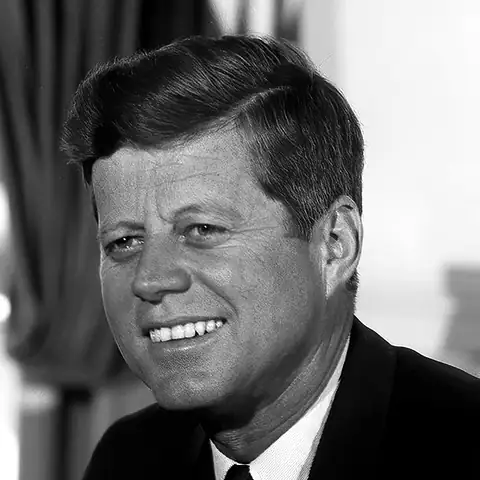
John F. Kennedy
Historical figureUnited States1917-1963

John F. Kennedy

35th President of the United States (1961-1963) · U.S. Senator from Massachusetts

Democratic president of the early 1960s, known for the New Frontier, the Cuban Missile Crisis, the race to the moon and his 1963 call for a civil rights law.

Profile on 12 axesAll 12 documented
ECONOMYSTATESOCIETYWORLDOwnershipMarketsWelfareAuthoritySecurityStructureMoralityReligionTechnologyCultureTradeForeign
Where they stood

John F. Kennedy, axis by axis

  1. PublicPrivate
  2. PlannedFree
  3. SharedSelf-reliant
  4. DemocraticStrong leader
  5. LibertyOrder
  6. LocalCentral
  7. ProgressiveTraditional
  8. SecularReligious

    As the first Catholic president he promised to keep church and state apart and opposed federal money for church schools.

  9. EmbraceCaution

    This comes from his strong public support for the space program, and nothing is recorded on regulating other technologies.

  10. MulticulturalNational identity

    The score draws mostly on his 1963 civil rights bill and his open rhetoric, and his short time in office limits the record.

  11. GlobalProtected

    Inferred from his support for freer postwar trade and closer Western economic ties, which was a smaller theme than security.

  12. CooperationStrength

    Cold War toughness, shown by the Bay of Pigs and a deepening role in Vietnam, sat beside arms control such as the 1963 test limits.

Who was John F. Kennedy?

John F. Kennedy was a Democrat from Massachusetts who served in the House and then the Senate. In 1960 he narrowly won the presidency, and he became both the youngest person elected to the job and the first Catholic. His New Frontier plan asked for federal action on schools, medical care for older people, economic growth and civil rights, but Congress held up much of it while he lived. Most of his time in office was shaped by the Cold War, with tense standoffs over Cuba and Berlin. An assassin shot him in Dallas in November 1963.

Political views

  • He asked for federal money for schools and for medical care for older people, and he got a higher minimum wage, but other plans stalled in Congress.Source: millercenter.org
  • As a Catholic president he kept to a strict wall between church and state and opposed federal aid to church schools.Source: millercenter.org
  • In a national address in June 1963 he called civil rights a moral issue and sent Congress a broad civil rights bill.Source: presidency.ucsb.edu
  • He gave the go-ahead for the failed 1961 exile landing at the Bay of Pigs, and in 1962 he ordered a naval blockade to make the Soviets pull their missiles out of Cuba.Source: millercenter.org
  • In 1961 he announced the Alliance for Progress for Latin America, and by executive order he founded the Peace Corps to send volunteers abroad.Source: millercenter.org
  • He backed the space program and set the goal of putting a man on the moon.Source: millercenter.org
  • In 1963 he signed on with Britain and the Soviet Union to a treaty limiting nuclear tests.Source: millercenter.org

Legacy

Kennedy stays among the best-liked presidents in polls. Admirers point to his speeches, the peaceful end of the Cuban Missile Crisis, the space program and his stand on civil rights as things that drew a generation into public service. Critics, and many historians, say he got little through Congress. They call the Bay of Pigs a costly failure and say his government pulled the United States deeper into Vietnam. Later conservatives pointed to his tax-cut plan and his anticommunism. Liberals stress his civil rights and social goals. Both camps therefore claim a share of his record.

In their own words

“We are confronted primarily with a moral issue. It is as old as the scriptures and is as clear as the American Constitution.”
Radio and Television Report to the American People on Civil Rights, 1963

How close are you to John F. Kennedy?

Take the 12 Axes test and see which historical figure is your political twin, axis by axis.

Take the test

John F. Kennedy: questions

Was JFK a liberal or a conservative?

On home affairs he was a mainstream liberal Democrat of his day, backing federal aid to schools, medical care for older people and civil rights. Abroad he was a hard-line Cold War anticommunist. He also asked for tax cuts to boost growth.

What was the New Frontier?

It was the name Kennedy gave his program in 1960. It covered education, medical care for the elderly, growth, civil rights and the space program.

Which party was John F. Kennedy in?

He was a Democrat. He sat for Massachusetts in the House and Senate and beat Richard Nixon for the presidency in 1960.

Sources