12axes-testTake the test
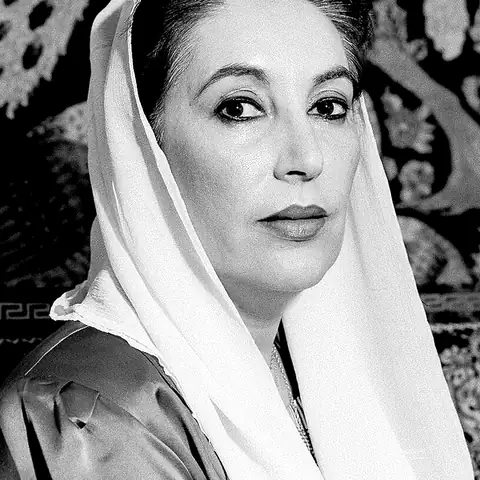
Benazir Bhutto
Historical figurePakistan1953-2007

Benazir Bhutto

11th and 13th Prime Minister of Pakistan (1988-1990, 1993-1996) · Chairperson of the Pakistan Peoples Party

Pakistani politician who led the Pakistan Peoples Party, became one of the first women to head a government in a Muslim-majority country, and was killed in 2007 while campaigning.

Profile on 12 axes8 of 12 documented
ECONOMYSTATESOCIETYWORLDOwnershipMarketsWelfareAuthoritySecurityStructureMoralityReligionTechnologyCultureTradeForeign
Where they stood

Benazir Bhutto, axis by axis

  1. PublicPrivate

    Headed a party born from her father's socialist populism, yet in her second term backed privatisation and a freer economy. Her score sits just past the middle.

  2. PlannedFree
  3. SharedSelf-reliant
  4. DemocraticStrong leader

    She spent decades opposing army rule and won two elections. But she led a family-run party and made a deal in 2007 to share power with General Musharraf. Her score leans toward democratic checks.

  5. LibertyOrder

    Her second government stepped up internal security operations and broke up opposition rallies. Abuse of people in custody stayed common. Her score leans toward order.

  6. 06StructureNo clear record
    LocalCentral
  7. ProgressiveTraditional

    She offered a modern image and supported advancing women. The Hudood Ordinances stayed in force under her, and she opposed legal abortion. Her score is at the centre.

  8. SecularReligious
  9. 09TechnologyNo clear record
    EmbraceCaution
  10. 10CultureNo clear record
    MulticulturalNational identity
  11. 11TradeNo clear record
    GlobalProtected
  12. CooperationStrength

    She eased tension with India in 1988-1989, yet backed the Kashmiri cause, and in 1996 her government gave the Taliban recognition. Her score leans mildly toward strength.

4 axes have no clear record, so matching leaves them out.

Who was Benazir Bhutto?

Benazir Bhutto came into the world in Karachi in 1953. Her father, Zulfikar Ali Bhutto, set up the Pakistan Peoples Party (PPP) and went on to lead the country. She studied at Harvard and Oxford, where she headed the Oxford Union. General Zia ul-Haq seized power and had her father executed. She then endured jail and exile while taking charge of the PPP. After Zia died she won the 1988 election. She held the top job twice, in 1988-1990 and 1993-1996. On 27 December 2007, an attack at a Rawalpindi rally killed her.

Political views

  • Fought General Zia's military government for years, from prison and from exile, and drew very large crowds when she came home in 1986.Source: news.bbc.co.uk
  • Set herself up as a modern woman leader facing a male-run establishment, and many later saw her as a symbol for women's rights.Source: en.wikipedia.org
  • Left in place the Hudood Ordinances brought in under Zia, which let down liberals and women's rights campaigners.Source: en.wikipedia.org
  • In her second government she pushed privatisation and spoke more openly in favour of a liberal economic course.Source: en.wikipedia.org
  • Described her government's links with the Taliban as political engagement meant to calm the movement and steady Afghanistan. She denied sending military help.Source: theguardian.com
  • Found it hard to remove the president's power to sack elected governments, even after she survived a no-confidence vote that former intelligence officers had backed.Source: bbc.com
  • Spent 2007 campaigning against militancy and warning that the coming election might be rigged.Source: theguardian.com

Legacy

Supporters see Bhutto as a face of democracy and modern ideas in Pakistan, and as a trailblazer for women in public life. In the West, governments treated her as a liberal friend in the struggle with militants. Her death made her a martyr in the PPP, now led by her husband Asif Ali Zardari and her son Bilawal. Critics note that both of her governments were dismissed, with charges of corruption and poor management. She said those charges were politically driven. A 1999 conviction was later overturned after signs of pressure on the judge. Critics also raise the corruption claims against her husband, the recognition of the Taliban in 1996, and her 2007 deal with General Musharraf, a move some called a betrayal of the democratic cause.

How close are you to Benazir Bhutto?

Take the 12 Axes test and see which historical figure is your political twin, axis by axis.

Take the test

Benazir Bhutto: questions

Where did Benazir Bhutto sit on the left-right scale?

Her party had socialist roots and she projected a secular, modern image, so it is usually placed centre-left. In office, though, she pursued privatisation and more market-friendly policies.

How did Benazir Bhutto die?

She was killed on 27 December 2007 after a campaign rally in Rawalpindi, when a gunman and a suicide bomber struck. Officials pointed at Baitullah Mehsud of the Pakistani Taliban, who denied it. A UN inquiry said her death could have been prevented.

Which party did Benazir Bhutto lead?

The Pakistan Peoples Party, founded by her father. She took it over during her 1980s exile and chaired it until her death.

Sources

Portrait: Oliver Mark - Benazir Bhutto, Dubai 2006 (cropped).jpg by Unknown author, CC BY-SA 4.0, via Wikimedia Commons. Cropped and converted to grayscale by 12axes-test.com.