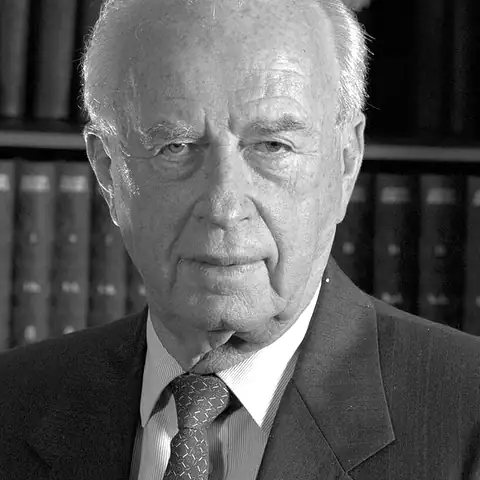
Who was Yitzhak Rabin?
Jerusalem was Rabin's birthplace, in 1922. He enlisted in the Palmach, the Haganah's strike force, in 1940, and in the 1948 war he led the Harel Brigade. Later he became chief of staff and directed the army in the Six-Day War of 1967. After a spell as ambassador in Washington he took over as prime minister in 1974, at the time the youngest man in the job. He served as defence minister between 1984 and 1990 and won the premiership again in 1992. He received the Nobel Peace Prize in 1994 with two others. In 1995 he was killed by a far-right Israeli as he left a Tel Aviv peace rally.
Political views
- In 1985, while running defence, he began a harsh West Bank line called 'Iron Fist'. It brought back detention without trial, home demolitions and deportations.Source: en.wikipedia.org
- Sent the army to crush the first intifada, then came to believe that Palestinians could not be ruled by force forever and that only a negotiated settlement would work.Source: news.bbc.co.uk
- Signed the 1993 Oslo deal with the PLO and, at the White House, shook hands with Yasser Arafat.Source: news.bbc.co.uk
- Was in charge when Israel and Jordan signed a peace treaty in 1994.Source: en.wikipedia.org
- Pushed Israel's economy away from state control through privatisation, and started Yozma, a scheme to attract foreign venture money into Israeli high technology.Source: en.wikipedia.org
- In his first term he gave priority to economic growth, social problems and a stronger army, and he ordered the Entebbe rescue in 1976.Source: nobelprize.org
- Argued that democracies have to fight sometimes in order to protect their people, yet that only peace could truly protect lives.Source: nobelprize.org
Legacy
Supporters see Rabin as a general who spent his security credentials to win Israelis over to compromise. His murder made him a symbol for the peace camp. Those who back Oslo say he secured the first recognition of each side by the other, and peace with Jordan. Right-wing opponents described the accords as a betrayal. Hamas and other groups responded with suicide attacks. Palestinians and many historians also blame him for the 1948 expulsion of Arab residents from Lydda and Ramle. Critics further condemned the harsh tactics used against the intifada.
In their own words
“There is only one radical means of sanctifying human lives. Not armored plating, or tanks, or planes, or concrete fortifications. The one radical solution is peace.”