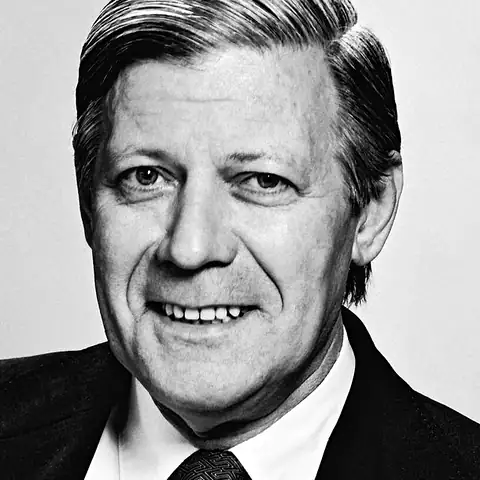
Who was Helmut Schmidt?
Helmut Schmidt was a Social Democrat from Hamburg. The country first noticed him when he ran the rescue work during the North Sea flood of 1962. Under Willy Brandt he served first as defence minister and then as finance minister. When Brandt quit in 1974, Schmidt took over as chancellor. His years in power brought recession, two oil crises and a wave of terror from the Red Army Faction. His government fell in 1982 when the FDP quit the coalition and parliament voted him out. Afterward he co-published the weekly paper Die Zeit and kept his Bundestag seat until 1987. He died at 96 in his home city in 2015.
Political views
- During the 1970s recession he made economic stability and jobs the top aims of his government.Source: hdg.de
- In the 1977 Schleyer kidnapping he would not give in to the Red Army Faction, and he approved the commando raid that freed the hijacked Landshut jet in Mogadishu.Source: hdg.de
- In 1969 he published a book on security called Strategie des Gleichgewichts, or Strategy of Balance.Source: hdg.de
- In 1977 he raised the alarm over new Soviet SS-20 rockets, and he was a driving force behind NATO's 1979 double-track decision.Source: hdg.de
- He opposed nuclear weapons for the German army in 1958, yet later supported modernizing NATO's missiles to restore the balance of power.Source: hdg.de
- With French president Valéry Giscard d'Estaing he built European monetary cooperation, including the creation of the European Monetary System, and he later favored a European central bank.Source: hdg.de
- He did not want nuclear power phased out.Source: en.wikipedia.org
- As Hamburg's interior senator in the 1962 flood he called in the Bundeswehr, a move whose legality was disputed at that time.Source: hdg.de
Legacy
Many remember Schmidt as a steady crisis manager and statesman. They say his firm stand in the 1977 terror crisis, together with his backing of the double-track plan, made the Western alliance stronger. Others, especially in his own party's left wing, fought his missile plans and his backing of nuclear power, which helped the Greens grow. In old age many admired him as a commentator, although what he said on immigration and integration was criticized. He said he bore personal blame for the killing of Hanns-Martin Schleyer, which followed the government's refusal to meet the kidnappers' demands. Some still hold this up as a model of political accountability.