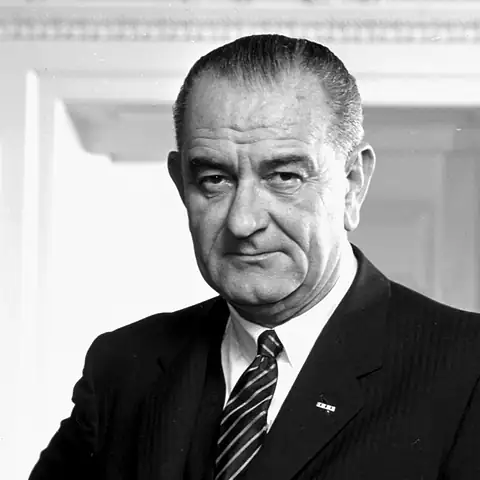
Who was Lyndon B. Johnson?
Lyndon Johnson was a Texan who spent years in Congress and became one of the most skilled Senate Majority Leaders. John F. Kennedy chose him as his running mate, and he was vice president when Kennedy was assassinated in November 1963. He then took the presidency and won a landslide in 1964 against Barry Goldwater. He used his deal-making skills to push through a huge set of laws he called the Great Society. They dealt with civil rights, poverty, health, schools and immigration. The war in Vietnam grew until it split the nation, and in 1968 he chose not to run again.
Political views
- In 1964 he put his name to the Civil Rights Act. It outlawed segregation in public places and bias in hiring.Source: millercenter.org
- He drove through the 1965 Voting Rights Act, aimed at the barriers that kept Black Southerners from the ballot.Source: millercenter.org
- His 1965 Social Security amendments created Medicare for the elderly and Medicaid for poor families.Source: millercenter.org
- His War on Poverty created Head Start, among other things, and lawyers for low-income families.Source: millercenter.org
- In 1965 he signed an immigration law that phased out quotas based on where people were born.Source: millercenter.org
- After winning the Gulf of Tonkin Resolution in 1964, he built up American forces in Vietnam until they hit 536,000 at the end of 1968.Source: millercenter.org
- He also took the United States into the Nuclear Nonproliferation Treaty of 1968.Source: millercenter.org
Legacy
Supporters count Johnson among the most effective presidents at getting laws passed. They credit him with the big civil rights acts, Medicare and Medicaid, federal money for schools and an immigration system with no national-origin quotas. Conservative critics say the Great Society raised spending and dependence without ending poverty, and shifted authority away from the states. Critics of all kinds blame him for deepening the Vietnam War and for the gap between what officials said and what was happening on the ground. That gap wore down public trust, and his approval fell sharply before he left office.
In their own words
“The Great Society rests on abundance and liberty for all. It demands an end to poverty and racial injustice, to which we are totally committed in our time.”