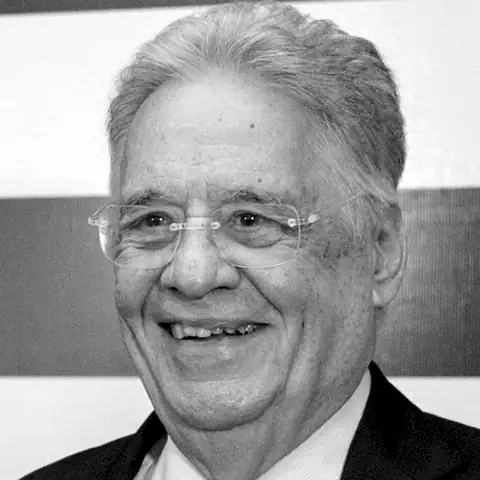
Who is Fernando Henrique Cardoso?
Known as FHC, Fernando Henrique Cardoso was born in 1931 in Rio de Janeiro and became a professor of sociology in São Paulo. The 1964 coup sent him into exile in Chile, where he and Enzo Faletto wrote a famous study of Latin American dependency. At home again, he lost his university post, joined the opposition MDB and won a Senate seat. In 1988 he was among the founders of the PSDB. Under President Itamar Franco he was finance minister, and his team created the Real Plan. Its success carried him to the presidency in 1994. After Congress allowed a second term, he won again in 1998. He holds no elected office now and heads an institute named for him.
Political views
- The 1997 sale of the mining giant Vale do Rio Doce was the most disputed part of a wide privatization drive.Source: www18.fgv.br
- A 1997 law he signed restructured the National Privatization Program, opening utilities and services to sale.Source: planalto.gov.br
- Signed the Fiscal Responsibility Law of 2000, which capped spending and debt at every level of government.Source: planalto.gov.br
- Launched Bolsa Escola in 2001, a monthly payment to families on condition that their children attend school.Source: planalto.gov.br
- In 1995 he signed a law that officially recognized as dead people who vanished for political reasons from 1961 to 1979, so families could seek compensation.Source: planalto.gov.br
- Backed the 1997 amendment that let presidents, governors and mayors seek a second term in a row.Source: planalto.gov.br
- Was a founding member of the Global Commission on Drug Policy, a group that wants regulation to replace prohibition.Source: globalcommissionondrugs.org
Legacy
Supporters say Cardoso secured the Real Plan, stopped years of runaway inflation and cleaned up public finances. They also say privatization spread phone access, and that his calm handover of power to Lula in 2003 showed a mature democracy. Critics on the left say he sold state assets too cheaply, let public debt grow through high interest rates and left unemployment high. They call his policy neoliberal. Press reports claimed some deputies were paid to vote for the 1997 reelection amendment, and he denied any part in that. A sharp fall in the currency in January 1999 hurt his popularity. After his presidency he wrote and spoke often about democracy and drugs.