12axes-testTake the test
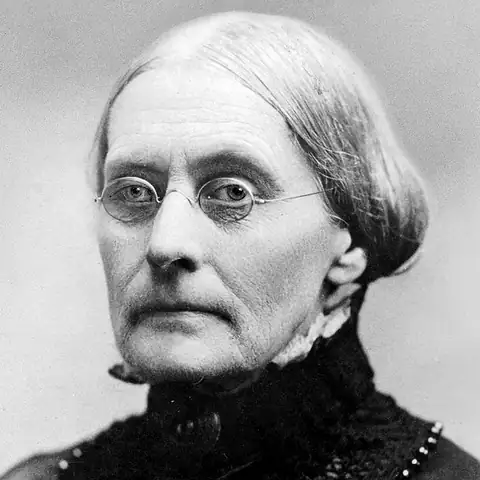
Susan B. Anthony
Historical figureUnited States1820-1906

Susan B. Anthony

Women's suffrage leader · President of the National American Woman Suffrage Association

Reformer from a Quaker family who fought slavery and drink, then led the American push for a federal women's voting amendment and was arrested for casting a ballot in 1872.

Profile on 12 axes6 of 12 documented
ECONOMYSTATESOCIETYWORLDOwnershipMarketsWelfareAuthoritySecurityStructureMoralityReligionTechnologyCultureTradeForeign
Where they stood

Susan B. Anthony, axis by axis

  1. 01OwnershipNo clear record
    PublicPrivate

    She had no worked-out view on who should own the economy, so that axis is null, and so are markets, welfare, technology, trade and foreign policy.

  2. 02MarketsNo clear record
    PlannedFree
  3. 03WelfareNo clear record
    SharedSelf-reliant
  4. DemocraticStrong leader
  5. LibertyOrder

    Voting in 1872 was deliberate civil disobedience, yet she also backed temperance laws. The score leans slightly toward liberty.

  6. LocalCentral

    A federal amendment was her chosen route, rather than winning one state at a time, so the score leans central.

  7. ProgressiveTraditional

    She was progressive for her day on equal legal and political standing for women, while sharing the temperance movement's aim of moral reform.

  8. SecularReligious
  9. 09TechnologyNo clear record
    EmbraceCaution
  10. MulticulturalNational identity

    The National Park Service records the insulting claims she and Stanton made about African American men in the Fifteenth Amendment fight, so the score is mild.

  11. 11TradeNo clear record
    GlobalProtected
  12. 12Foreign policyNo clear record
    CooperationStrength

6 axes have no clear record, so matching leaves them out.

Who was Susan B. Anthony?

Raised a Quaker, Susan B. Anthony was born in Adams, Massachusetts. Her family moved near Rochester, New York, and held antislavery meetings on their farm. She worked as a teacher, took up temperance and the antislavery cause, and from 1851, after she met Elizabeth Cady Stanton, spent her life organising for women's rights. She worked for the American Anti-Slavery Society and in 1869 helped found a suffrage association of her own. When the rival groups merged, she led the combined body from 1892 until 1900. The Nineteenth Amendment of 1920 is often nicknamed for her.

Political views

  • Pressed for married women's right to own property and for the vote for women in New York State.Source: nps.gov
  • Took a job as an agent for the American Anti-Slavery Society in 1856.Source: nps.gov
  • Told an 1857 teachers' convention that women and Black Americans should be educated.Source: susanb.org
  • Made a national constitutional amendment the main goal for winning women the vote.Source: nps.gov
  • Cast a ballot in the 1872 presidential election as a test of the law, and was tried and fined.Source: nps.gov
  • Set up groups for women who worked in the printing and garment trades.Source: susanb.org

Legacy

Anthony became the face of the suffrage movement. Admirers say her decades of speeches, petitions and organising built the national campaign that ended with the Nineteenth Amendment, and in 1979 she became the first real woman shown on regular US coins. Historians also note its darker side. When the Fifteenth Amendment gave the vote to Black men and not to women, she and Stanton split from old allies, among them Frederick Douglass, who was hurt by their insulting arguments about African Americans, as the National Park Service records. The suffrage history she helped write centres white women and leaves out most women of colour. The Park Service adds that her 1873 trial verdict closed off an appeal to the Supreme Court.

In their own words

“I know slavery is the all-absorbing question of the day, still we must push forward this great central question, which underlies all others.”
Letter to Matilda Joslyn Gage, 1854

How close are you to Susan B. Anthony?

Take the 12 Axes test and see which historical figure is your political twin, axis by axis.

Take the test

Susan B. Anthony: questions

Which party did Susan B. Anthony belong to?

She was not tied to one party. She worked through reform groups for abolition, temperance and suffrage, and she judged parties by whether they would back votes for women.

What did Susan B. Anthony fight for?

Slavery, drink and unequal laws all drew her fire, but votes for women mattered most. She died in 1906, fourteen years before the Nineteenth Amendment passed.

Was Susan B. Anthony arrested?

Yes. She voted in Rochester in the 1872 election, was arrested, tried and fined $100. She refused to pay it.

Sources