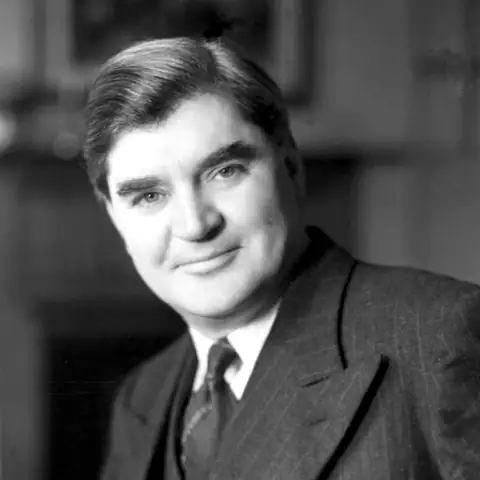
Who was Aneurin Bevan?
Aneurin Bevan grew up in the Welsh mining town of Tredegar, where his father worked in the pits. He left school at 13 and went underground as a teenager, while teaching himself politics and economics from the books at the miners' library. He rose in the miners' union, studied in London and worked as a union agent during the 1926 strike. Voters in Ebbw Vale sent him to Parliament in 1929, and he kept the seat until he died. Labour briefly expelled him in 1939. After the 1945 election Clement Attlee made him Minister of Health, with housing in his brief. In the 1950s he led the party's left wing and became deputy leader in 1959.
Political views
- In 1946 he introduced the National Health Service Bill to the Commons and argued that care should be open to everyone, with no insurance test to pass first.Source: api.parliament.uk
- He took the hospitals into national ownership and paid for the service out of general taxes.Source: biography.wales
- He bargained with the doctors' leaders until the service opened in 1948, and was willing to give ground to get it started.Source: biography.wales
- The National Assistance Act of 1948 swept away the old Poor Law and put national welfare services in its place.Source: biography.wales
- He backed council house building and factory-made prefab homes to fix the housing shortage left by the war.Source: biography.wales
- He quit the government in 1951 because ministers wanted to bring in charges within the health service.Source: biography.wales
Legacy
Most people remember Bevan as the man who built the NHS. Admirers on the left see him as a champion of public services and democratic socialism, and his name still turns up in debates about health care. Critics at the time, including the British Medical Association and many Conservatives, feared too much state control over medicine. Some also disliked his harsh words about opponents. Inside Labour, his followers, known as the Bevanites, fought the party's right wing over arms spending and defence. He became deputy leader in 1959 and died the following year.
In their own words
“The first reason why a health scheme of this sort is necessary at all is because it has been the firm conclusion of all parties that money ought not to be permitted to stand in the way of obtaining an efficient health service.”