12axes-testTake the test
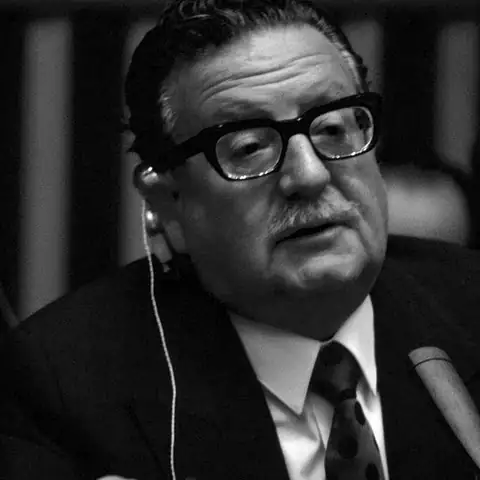
Salvador Allende
Historical figureChile1908-1973

Salvador Allende

President of Chile (1970-1973) · Co-founder of the Socialist Party of Chile

Allende was a doctor and Socialist who won Chile's presidency in 1970 and tried to build socialism through elections. A military coup ended his government in 1973.

Profile on 12 axes11 of 12 documented
ECONOMYSTATESOCIETYWORLDOwnershipMarketsWelfareAuthoritySecurityStructureMoralityReligionTechnologyCultureTradeForeign
Where they stood

Salvador Allende, axis by axis

  1. PublicPrivate

    Copper and the banks were taken into public hands and a large social property sector was planned, yet he left room for mixed and private business. That is why the score is not at the extreme.

  2. PlannedFree
  3. SharedSelf-reliant
  4. DemocraticStrong leader

    He vowed to reach socialism by constitutional means. In 1973, though, the opposition-controlled Chamber of Deputies accused his government of breaking the constitution. The score leans democratic, with that dispute in mind.

  5. LibertyOrder
  6. LocalCentral
  7. ProgressiveTraditional
  8. SecularReligious
  9. EmbraceCaution

    His government supported the Cybersyn computer project to help manage the economy, which gives a mild lean toward embracing technology.

  10. 10CultureNo clear record
    MulticulturalNational identity

    No lasting stance on immigration or national cultural identity is documented, so this axis is left empty.

  11. GlobalProtected
  12. CooperationStrength

One axis has no clear record, so matching leaves it out.

Who was Salvador Allende?

Salvador Allende was born in Valparaíso in 1908 and qualified as a physician. In 1933 he helped found Chile's Socialist Party. He later served as health minister and sat for many years in the Senate. He ran for president three times and lost, then won in 1970 leading the Popular Unity alliance. That made him one of the first Marxists to take power in a free national election. His term brought inflation, strikes and secret American efforts against him. On 11 September 1973, General Augusto Pinochet's forces attacked the presidential palace, and Allende died inside it.

Political views

  • He wanted the state to control Chile's copper, iron and steel, to hold the banks and to own the strategic industries on behalf of society.Source: marxists.org
  • His plan kept a mixed economy, with a space for private firms next to the state sector.Source: marxists.org
  • In 1971 he nationalized the copper mines. He defended the move and charged that foreign companies were working to weaken his government.Source: marxists.org
  • He told the United Nations that Chile was building socialism while keeping civil liberties and a range of political views.Source: marxists.org
  • He promised to obey the constitution and the law, and during the 1973 coup he refused to step down.Source: marxists.org
  • Declassified US records show that Washington secretly tried to stop him taking office and later to undermine his government.Source: nsarchive2.gwu.edu

Legacy

Many on the left in Latin America and beyond see Allende as an elected reformer brought down with American help, and they still recall his last radio speech. Supporters credit him with bigger social programs and with the copper takeover, which later governments did not reverse. Critics, among them the Christian Democrats of the day, say his policies caused shortages and very high inflation and that his coalition pushed the constitution to its limits. Historians still argue over how far home-grown and foreign causes explain the coup and the 17 years of dictatorship that followed. US documents released by the National Security Archive show covert action against him, and they keep shaping that argument.

In their own words

“They have strength and will be able to dominate us, but social processes can be arrested neither by crime nor force. History is ours, and people make history.”
Last radio address to the nation, 11 September 1973 (English translation)

How close are you to Salvador Allende?

Take the 12 Axes test and see which historical figure is your political twin, axis by axis.

Take the test

Salvador Allende: questions

Was Salvador Allende a communist?

He described himself as a Marxist and a socialist. His own party was the Socialist Party, but the Communist Party sat in his alliance. He said he would pursue his goals by winning votes and obeying the constitution.

How did Salvador Allende die?

He was found dead in the La Moneda palace on 11 September 1973, while the military coup was happening. Chilean investigations concluded he took his own life, but some people dispute that.

Which party did Allende lead?

He co-founded Chile's Socialist Party in 1933. In 1970 he won the presidency as the candidate of Popular Unity, an alliance of left-wing parties.

Sources