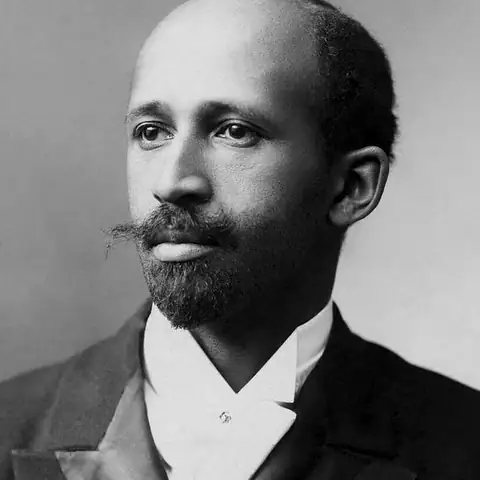
Who was W. E. B. Du Bois?
Born in Great Barrington, Massachusetts, in 1868, Du Bois earned a Harvard doctorate in 1895, the first awarded to a Black American. His 1903 book The Souls of Black Folk popularized the notion of double consciousness. In 1905 he helped start the Niagara Movement and, soon after, the NAACP. He edited the NAACP's journal The Crisis from 1910 to 1934. From 1919 he arranged a series of Pan-African congresses. In 1951 he was indicted for failing to register as a foreign agent because of his peace work, and the court dismissed the case. Du Bois moved to Ghana in 1961. He died in Accra two years later.
Political views
- Rejected Booker T. Washington's bargain, in which Black Americans would accept reduced rights in exchange for training in trades.Source: naacp.org
- Held that a Talented Tenth of well-schooled Black leaders ought to lead the wider community upward.Source: plato.stanford.edu
- Ran a campaign in The Crisis against lynching, and the magazine reached 100,000 readers by 1920.Source: naacp.org
- Convened Pan-African congresses in 1919, 1921, 1923 and 1927, seeking to join the struggles of people of African descent across the world.Source: naacp.org
- Argued that democracy in industry counts for more than democracy at the ballot box, and defended a democratic kind of socialism.Source: plato.stanford.edu
- Became a member of the Communist Party in 1961, objecting to the McCarran Internal Security Act and declaring his belief in communism.Source: en.wikipedia.org
Legacy
Du Bois gets credit for shaping the modern civil rights movement, for pioneering data-based sociology and for leading Pan-Africanism. Admirers say that his books The Souls of Black Folk and Black Reconstruction changed how Americans think about race, slavery and democracy. Critics say the Talented Tenth was an elitist idea. They also object to his 1918 Close Ranks editorial, which asked Black Americans to set grievances aside in wartime, and to his friendly writing about Imperial Japan in the 1930s. He drew lasting criticism for praising Stalin in 1953 and for admiring accounts of the Soviet Union and China following a visit in 1958-1959. The US government kept his passport from him for most of the 1950s.
In their own words
“The problem of the twentieth century is the problem of the color-line.”