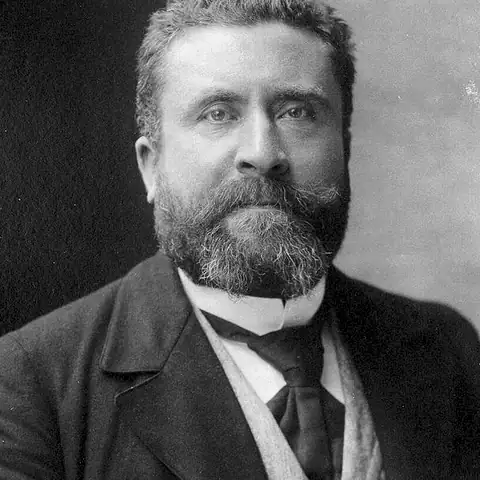
Who was Jean Jaurès?
Jean Jaurès was born in Castres and trained as a teacher of philosophy. In 1885 voters in the Tarn sent him to the Chamber of Deputies as a moderate republican. His support for striking miners at Carmaux in 1892 pulled him toward socialism, and in 1893 he returned there calling himself an independent socialist. He hesitated at first over the Dreyfus case, then became one of its most active defenders. From 1902 he headed the French Socialist Party, and in 1904 he started the newspaper L'Humanité. In 1905 he and Jules Guesde brought the rival socialist groups together in the SFIO. His writing includes a Socialist History of the French Revolution. A nationalist named Raoul Villain shot him dead in Paris on 31 July 1914.
Political views
- Took Alfred Dreyfus's side and collected the evidence that he was innocent in the 1898 book Les Preuves.Source: fr.wikipedia.org
- Backed the decision of the socialist Alexandre Millerand to join the Waldeck-Rousseau government, which split French socialists.Source: en.wikipedia.org
- Kept the left-wing bloc united long enough for the 1905 law to separate church from state.Source: en.wikipedia.org
- Preferred to spread property ownership more democratically and to collectivise parts of the economy by consent, instead of abolishing private property.Source: fr.wikipedia.org
- Argued for an income tax that rises with earnings, in place of an unequal system of taxes.Source: fr.wikipedia.org
- Set out a plan for a citizens' defensive army in L'Armée nouvelle, published in 1910.Source: fr.wikipedia.org
- Treated empire-building as a threat to peace, and in 1913 he fought the law extending military service to three years.Source: en.wikipedia.org
- Also wrote about the death penalty, about socialist unity and about what a socialist programme should contain.Source: marxists.org
Legacy
Politicians from many camps lay claim to Jaurès. In 1924 his body was placed in the Panthéon, and speakers from the left and the right still hold him up as a model of republican belief and eloquence. Admirers say he tied socialism to democracy, secular schools and peace. Revolutionary Marxists like Guesde attacked his gradual approach, and in particular his backing for a socialist sitting in a middle-class government. Nationalists said his hostility to militarism was unpatriotic. After the war a jury cleared Villain in 1919, by 11 votes to 1.