12axes-testTake the test
Olof Palme
Historical figureSweden1927-1986

Olof Palme

Prime Minister of Sweden (1969-1976, 1982-1986) · Leader of the Swedish Social Democratic Party (1969-1986)

Swedish Social Democratic prime minister who widened the welfare state, spoke out loudly against the Vietnam War and apartheid, and was shot dead in Stockholm in 1986.

Profile on 12 axesAll 12 documented
ECONOMYSTATESOCIETYWORLDOwnershipMarketsWelfareAuthoritySecurityStructureMoralityReligionTechnologyCultureTradeForeign
Where they stood

Olof Palme, axis by axis

  1. PublicPrivate

    Supported wage earner funds that would give unions a share of company ownership. The plan was disputed and only a weakened version became law.

  2. PlannedFree
  3. SharedSelf-reliant
  4. DemocraticStrong leader
  5. LibertyOrder
  6. LocalCentral

    Sweden is a unitary state and he did not make decentralization a major cause. The score is near neutral.

  7. ProgressiveTraditional
  8. SecularReligious
  9. EmbraceCaution

    Accepted nuclear power as a bridge energy source, so he scores mildly toward embracing technology.

  10. MulticulturalNational identity
  11. GlobalProtected
  12. CooperationStrength

    Kept Sweden non-aligned while criticizing both superpowers openly and backing UN mediation and disarmament.

Who was Olof Palme?

Olof Palme was raised in a wealthy Stockholm family and studied at Kenyon College in the United States. In 1953 he became private secretary to Prime Minister Tage Erlander. He entered parliament in 1958 and held several ministries, education among them. When Erlander stepped down in 1969, Palme took over both the party and the government. Voters ousted him in 1976 and returned him in 1982. Few Swedes were better known abroad. A gunman killed him on a Stockholm street in 1986. No one was held responsible for decades, and prosecutors in 2020 pointed to a suspect who had died.

Political views

  • Widened the welfare state with housing support, social insurance reform and generous parental leave, paid for by high taxes.Source: encyclopedia.com
  • Aimed for a Sweden with more equality in outcomes, not just in opportunity.Source: encyclopedia.com
  • Backed wage earner funds, which would have put company profits into investment funds controlled by the unions.Source: encyclopedia.com
  • Spoke out early against apartheid in South Africa, and also criticized dictatorships of both left and right.Source: en.wikipedia.org
  • Attacked the US war in Vietnam, walked in a 1968 march beside North Vietnam's ambassador and likened the bombing of Hanoi to Guernica.Source: encyclopedia.com
  • Denounced the Soviet invasion of Czechoslovakia, and sought a middle path between the American and Soviet economic models.Source: encyclopedia.com
  • Chaired an independent commission on disarmament and security that took his name.Source: olofpalme.arbark.se
  • Accepted nuclear power as a step on the road to other energy sources, and pushed for a one-chamber parliament.Source: en.wikipedia.org

Legacy

Supporters see Palme as a major champion of social democracy, gender equality, an end to colonial rule and nuclear disarmament, and an international center carries his name. At home, opponents disliked high taxes, a growing bureaucracy and the wage earner funds, which sparked big demonstrations. In 1976 a tax row drove the film director Ingmar Bergman out of Sweden and became a symbol of resentment toward the tax office. Palme governed more cautiously in his last term as the economy struggled. His remarks on Vietnam strained ties with Washington, and some critics thought he went easy on left-wing governments, Cuba among them.

How close are you to Olof Palme?

Take the 12 Axes test and see which historical figure is your political twin, axis by axis.

Take the test

Olof Palme: questions

Was Olof Palme a socialist?

He was a democratic socialist who led the Swedish Social Democrats. He wanted a large welfare state, high taxes and more equality, but he worked within a market economy and elected government.

Why was Olof Palme famous abroad?

He was known for strong views on world affairs. He opposed the Vietnam War and apartheid, criticized Soviet actions, and supported disarmament, all while Sweden stayed outside the military blocs.

Who killed Olof Palme?

The shooting happened in Stockholm in February 1986. One man was convicted but was freed on appeal. In 2020 prosecutors said the likely gunman was Stig Engström, who was dead, and ended the investigation.

Sources

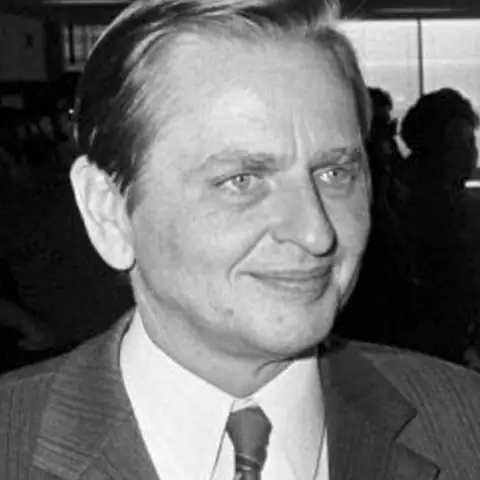
Portrait: Olof Palme 1974 (cropped).jpg by Bert Verhoeff for Anefo, CC BY-SA 3.0 nl, via Wikimedia Commons. Cropped and converted to grayscale by 12axes-test.com.