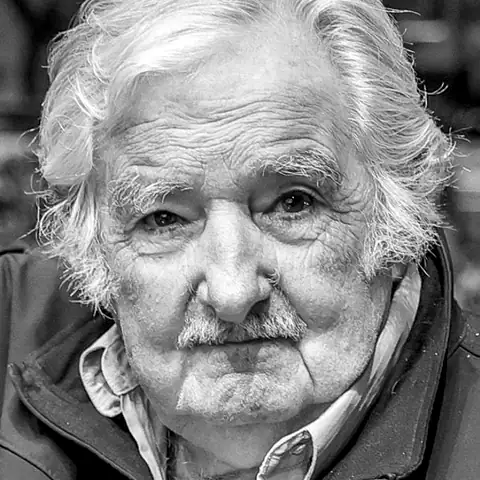
Who was José Mujica?
Montevideo was the birthplace of José Alberto Mujica Cordano, in 1935. His family was poor, and as a child he sold flowers with his mother. By the 1960s he was in the Tupamaros, an urban guerrilla group. Police shot him six times when they arrested him in 1970, and he broke out of prison twice. After the 1973 coup the army held him as a hostage for about twelve years, often in isolation. He walked free under the 1985 amnesty and helped found the Movement of Popular Participation inside the Broad Front coalition. Later he sat as a deputy and senator and served as agriculture minister, then won the presidency, which he held until 2015. He died at his farm on 13 May 2025.
Political views
- In 2013 he signed a law that put the state in charge of growing and selling cannabis, saying it would cut into the business of drug gangs.Source: bostonglobe.com
- He supported a 2012 law ending criminal penalties for early abortion, and he put his signature on marriage equality in 2013.Source: bostonglobe.com
- He said capitalism had to work so that there would be money to solve social problems. Under his government poverty fell and foreign investment grew.Source: bostonglobe.com
- He attacked consumerism and endless industrial growth, and at the 2012 Rio+20 summit he said leaders spoke up for the environment while ignoring what harms it.Source: bostonglobe.com
- Most of his presidential pay went to a state housing program, and he kept living at his farm instead of the official residence.Source: foreignpolicy.com
- His foreign policy kept Uruguay neutral in regional disputes. He helped mediate in Colombia's peace process, and in 2014 Uruguay took in six men who had been held at Guantanamo.Source: foreignpolicy.com
- At the UN General Assembly in 2013 he warned that people were not steering globalization, and that globalization was steering them.Source: foreignpolicy.com
Legacy
Mujica turned into an international symbol of the democratic left. The press nicknamed him the poorest president in the world, and Lula compared him with Nelson Mandela. Admirers point to steady growth, less poverty, more renewable energy and some of Latin America's most socially liberal laws, all without scandal or any attempt to extend his term. Critics, among them ex-president Julio María Sanguinetti, said style mattered more to him than substance and that institutions suffered. His economy minister and the head of a state bank quit over the 2013 liquidation of the airline Pluna, and both were later convicted for illegal decisions. Others faulted his hazy line on Venezuela's Nicolás Maduro. In Uruguay, people still argue about the Tupamaros' record in the 1960s and 1970s: kidnappings, bombings and the killing of security forces.