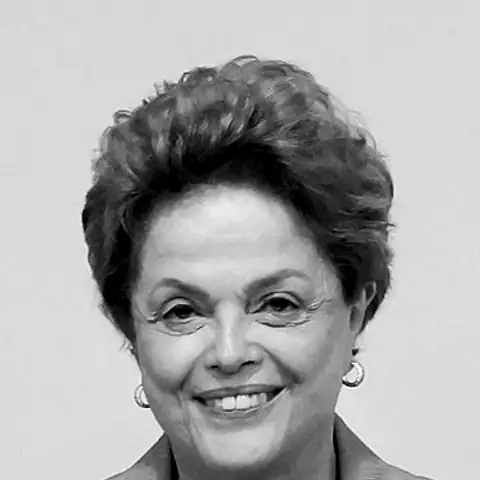
Who is Dilma Rousseff?
Dilma Rousseff comes from Belo Horizonte, where she was born in 1947 to a Bulgarian-born father. In her youth she took up arms with underground groups fighting Brazil's military rulers. Police seized her in São Paulo in 1970. She was tortured and stayed in prison until the end of 1972. Later she worked as an economist and energy official in the south, joined the Workers' Party in 2001 and served under Lula as energy minister and chief of staff. Voters made her president in 2010 and 2014. The Senate removed her in August 2016 over budget breaches. Today she heads the BRICS-backed New Development Bank, and holds no elected post in Brazil.
Political views
- In 2011 she founded the National Truth Commission, whose job was to investigate rights abuses from 1946 to 1988.Source: planalto.gov.br
- A 2012 law she signed gave half of all federal university seats to students from public schools, including set quotas for Black, mixed-race and Indigenous applicants.Source: planalto.gov.br
- Started Mais Médicos in 2013, which sent Brazilian and foreign doctors to areas with too few of them.Source: planalto.gov.br
- In 2014 she signed the Internet Civil Framework, a law on net neutrality, privacy and online free speech.Source: planalto.gov.br
- Under a provisional measure of 2012, power firms could renew licences only if they lowered their rates. It was a government-driven effort to bring down energy bills.Source: planalto.gov.br
- Her removal in 2016 followed a ruling by the Federal Accounts Court. It said her government had used accounting maneuvers called 'pedaladas fiscais' and spent through decrees Congress had not approved.Source: www18.fgv.br
Legacy
Her supporters see a woman who stood up to the dictatorship. They credit her governments with bigger social programs, quotas at universities, wider health care and a probe of past state crimes. They call the impeachment a parliamentary coup, because the charges were about budget rules, not personal enrichment, and she was allowed to keep her political rights. Critics blame her interventionist economics, including controls on fuel and power prices and cheap loans, for the deep recession of 2014-2016. They also hold her to account for the Petrobras bribery scheme, which went on while she chaired the company and later ran the country. On 31 August 2016 senators voted 61 to 20 to remove her.