12axes-testTake the test
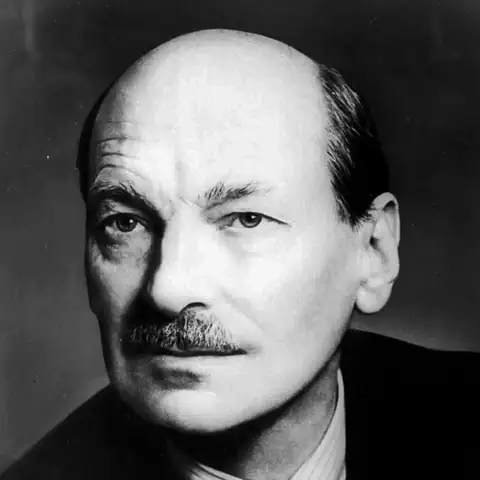
Clement Attlee
Historical figureUnited Kingdom1883-1967

Clement Attlee

Prime Minister of the United Kingdom (1945-1951) · Leader of the Labour Party (1935-1955)

Labour's prime minister between 1945 and 1951, whose ministers founded the National Health Service, took major industries into public hands and granted independence to India.

Profile on 12 axesAll 12 documented
ECONOMYSTATESOCIETYWORLDOwnershipMarketsWelfareAuthoritySecurityStructureMoralityReligionTechnologyCultureTradeForeign
Where they stood

Clement Attlee, axis by axis

  1. PublicPrivate
  2. PlannedFree
  3. SharedSelf-reliant
  4. DemocraticStrong leader
  5. LibertyOrder
  6. LocalCentral

    Ministers set up services run nationally, like the health service, and took industries into state ownership. His score leans toward central control.

  7. ProgressiveTraditional

    He had no big programme of social liberalisation as we would see it now. By the standards of his time, his score is close to neutral.

  8. SecularReligious
  9. EmbraceCaution
  10. MulticulturalNational identity

    A 1948 nationality law confirmed shared citizenship across the Commonwealth. Little else is recorded on immigration, so the score is only mild.

  11. GlobalProtected

    He kept wartime import and currency controls but also took Britain into the post-war GATT system. His score is mixed.

  12. CooperationStrength

    Britain joined the UN and NATO under him and India became independent, but he also kept big armed forces. His score leans mildly toward cooperation.

Who was Clement Attlee?

Born in London in 1883, Clement Attlee went to Oxford and trained as a lawyer. Work at a boys' club in east London turned him toward socialism, and he joined the Independent Labour Party in 1908. After army service in the First World War he was elected Mayor of Stepney, and in 1922 he won the Limehouse seat in Parliament. He took over as Labour leader in 1935 and served as deputy to Churchill in the wartime coalition. Labour won a landslide in 1945 with the programme Let Us Face the Future. The new government dealt with large debts, money crises and rationing that carried on. It held on narrowly in 1950 and lost power in 1951. Attlee stayed leader until 1955.

Political views

  • Ran in 1945 promising public ownership of key industries and the Bank of England. The manifesto also named a Socialist Commonwealth of Great Britain as the goal.Source: sourcebooks.web.fordham.edu
  • Told MPs in August 1945 that coal and the Bank of England would pass into public hands.Source: api.parliament.uk
  • Created the NHS, along with a national insurance scheme paying benefits to those out of work or unable to work.Source: gov.uk
  • Nationalised the mines, power supply, the railways and lorry haulage over long distances. Together these made up around a fifth of the economy.Source: gov.uk
  • Brought in controls on how land could be developed and created National Parks across England and Wales.Source: gov.uk
  • Presided over the end of British rule in India, Pakistan, Burma and Ceylon, and made Britain a backer of the UN.Source: gov.uk

Legacy

Admirers say the Attlee government built the post-war order in Britain, and polls of academics have often put him among the best prime ministers. Opponents, among them many Conservatives and free-market thinkers, say nationalisation and state controls held back recovery and that rationing went on too long. Some on the left felt he stopped short. The speed of Indian partition and what followed is still argued over. His calm, team-based style is often set against Churchill's. Governments of both main parties later kept much of what he built, the NHS above all.

In their own words

“At the General Election we set very plainly before the electors our policy of bringing under public ownership some of the main factors in the economic life of this country.”
Speech in the Debate on the Address, House of Commons, 16 August 1945

How close are you to Clement Attlee?

Take the 12 Axes test and see which historical figure is your political twin, axis by axis.

Take the test

Clement Attlee: questions

Was Clement Attlee a socialist?

Attlee spoke of Labour's aims as socialist, and the 1945 programme used the phrase Socialist Commonwealth. His government's actual result was a mixed economy with public ownership of key industries and a welfare state.

Which party did Attlee belong to?

Labour. He was its leader for twenty years, from 1935 to 1955, having started out in the Independent Labour Party in 1908.

What did the Attlee government achieve?

It created the National Health Service, expanded national insurance and nationalised coal, rail and other industries. It also gave independence to India and other colonies.

Sources