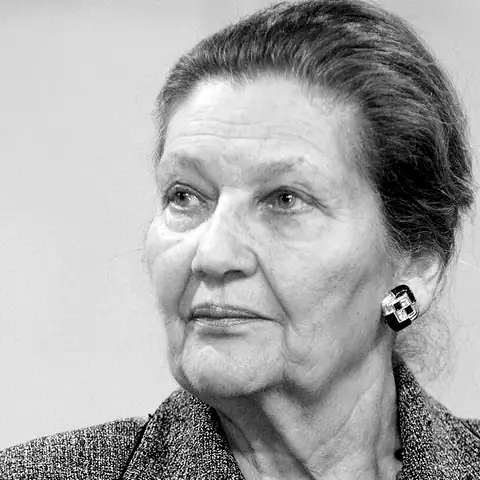
Who was Simone Veil?
Born Simone Jacob in Nice, she was deported in 1944 to Auschwitz-Birkenau with her mother and sister, and later to Bergen-Belsen, where her mother died. She then studied law and entered the magistracy in 1956. She worked on conditions for women in prison and on family law. Valéry Giscard d'Estaing named her health minister in 1974, and she drove contraception and abortion reform through parliament. For the first direct European elections in 1979 she topped her party's list, and the new Parliament elected her its president. Later she joined Édouard Balladur's cabinet, sat on the Constitutional Council and entered the Académie française in 2008.
Political views
- The loi Veil of 1975, which made abortion legal, was her work. She steered it through the National Assembly with the help of opposition votes.Source: european-union.europa.eu
- A law passed in December 1974 widened access to contraception.Source: en.wikipedia.org
- In 1979 she became President of the European Parliament, the first woman to lead an EU institution.Source: european-union.europa.eu
- She was a firm believer in a united Europe and said it should be more than a single economy.Source: theguardian.com
- As a minister she brought in support for mothers of small children, disabled people and patients with HIV.Source: en.wikipedia.org
- As a minister from 1993 to 1995, she was against widening the state's powers to control immigration.Source: theguardian.com
- In 2005 she stepped away from her seat on the Constitutional Council to speak for the draft EU constitution.Source: en.wikipedia.org
Legacy
In France many see Veil as a symbol of women's rights, remembering the Holocaust and European reconciliation. She received the Charlemagne Prize in 1981, led the Foundation for the Memory of the Shoah, and her remains were moved to the Panthéon in 2018. Defending the abortion bill in 1974, she faced fierce hostility, including attacks aimed at her family. Opponents of abortion still criticize the law named after her. Some critics said that campaigning for the EU constitution in 2005 hurt the Constitutional Council's neutrality, a charge she rejected. Colleagues also found her impatient and demanding.