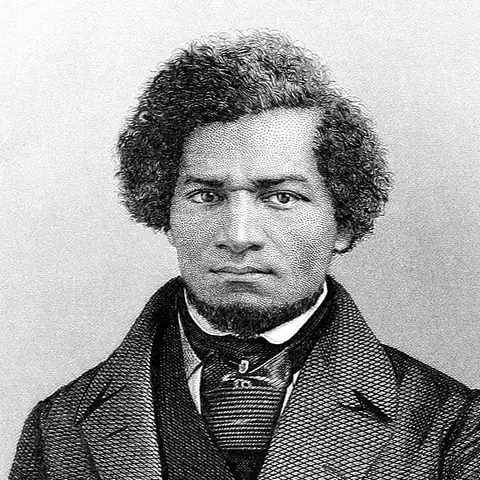
Who was Frederick Douglass?
Douglass began life enslaved on a Maryland farm in Talbot County and reached the North in 1838. Garrison's anti-slavery society soon made him one of its best speakers, and his 1845 autobiography brought him wide fame. He later parted ways with Garrison. He founded a paper, The North Star, and claimed that the Constitution was really an antislavery text. In the Civil War he helped to raise Black regiments and met Lincoln. Later he took federal jobs, including marshal in Washington and envoy to Haiti.
Political views
- Demanded that slavery end at once, since it broke the natural rights of every person.Source: plato.stanford.edu
- Backed a composite nation where people from many backgrounds hold equal citizenship.Source: plato.stanford.edu
- Argued for women's right to vote and for Black civil and political rights together.Source: plato.stanford.edu
- Held up work, property and self-made success as sources of dignity.Source: plato.stanford.edu
- Urged Lincoln to give Black Union soldiers the same pay and treatment as white ones.Source: nps.gov
- Separated the Christianity of Christ from the religion of slaveholders in his own country.Source: gutenberg.org
Legacy
Many historians rank Douglass with the greatest US reformers of the 1800s. His admirers come from across the spectrum. Liberals and progressives point to his case for racial equality, the vote and women's suffrage. Conservatives and libertarians cite his stress on self-reliance, property, the Constitution and self-made success. His autobiographies are still standard reading on slavery. Defenders of slavery hated him, and some allies criticised him too. Garrisonians disliked his turn to politics and his antislavery reading of the Constitution. Over the Fifteenth Amendment, which enfranchised Black men and left out women, he fell out with Elizabeth Cady Stanton and Susan B. Anthony. Some later Black nationalists questioned his integrationism and his opposition to emigration. Scholars still argue about how his views on assimilation apply today.
In their own words
“You have seen how a man was made a slave; you shall see how a slave was made a man.”