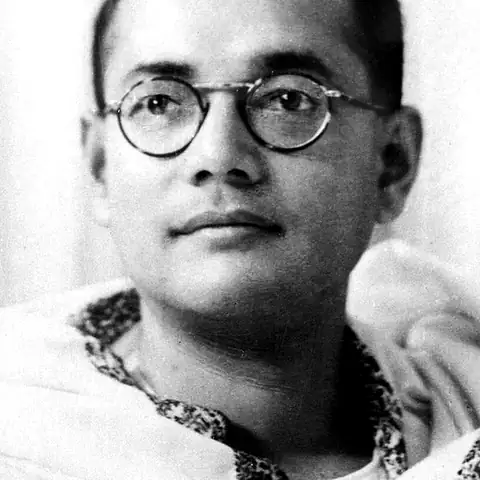
Who was Subhas Chandra Bose?
Subhas Chandra Bose, born in 1897 in Cuttack, rose through the Indian National Congress and became its president in 1938. He pressed for complete independence and clashed with Gandhi and the old guard, resigning in 1939 and founding the All India Forward Bloc. Jailed by the British several times, he escaped India and reached Berlin in 1941, then Japanese-held Asia in 1943. There he revived the Indian National Army and headed a government in exile. The army's push toward Imphal and Kohima failed. Bose is officially said to have died after a plane crash in Taiwan in August 1945.
Political views
- Pictured a free India that was modern, industrial, socialist and urban, in contrast to Gandhi's rural model, and wanted peasants and workers to live better.Source: bookforum.com
- Rejected Gandhi's hostility to science and medicine and demanded complete independence, a clash that ended with his resignation as Congress president.Source: bookforum.com
- Concluded that India needed socialist authoritarianism for at least two decades, loosely modeled on Ataturk, and doubted that democracy could carry out socialist reforms.Source: newworldencyclopedia.org
- Held that nonviolence alone would not win independence and favored armed resistance.Source: newworldencyclopedia.org
- Envisioned a country where Hindus, Muslims, Christians and Sikhs would have equal voices in governing.Source: bookforum.com
- Went to Berlin in 1941 believing Britain would lose the war, set up a Free India Center and radio station, and met Hitler, who never issued a declaration of Indian independence.Source: bookforum.com
- Opposed Germany's invasion of the Soviet Union and told Ribbentrop that Indian opinion was sympathetic to the socialist USSR.Source: revolutionarydemocracy.org
Legacy
In India he is revered as Netaji, the respected leader, and admirers credit him with an uncompromising demand for freedom and with building the Indian National Army. Critics point to his alliance with Nazi Germany and Imperial Japan, regimes responsible for mass killing. The scholar Romain Hayes faults him for never voicing concern about the millions killed in the camps, and the Indian Legion he raised swore loyalty to Hitler. His defenders, such as the historian Sugata Bose, say he had no affinity with Axis ideology. The Indian National Army campaign ended in defeat, and the circumstances of his death are still disputed.