12axes-testTake the test
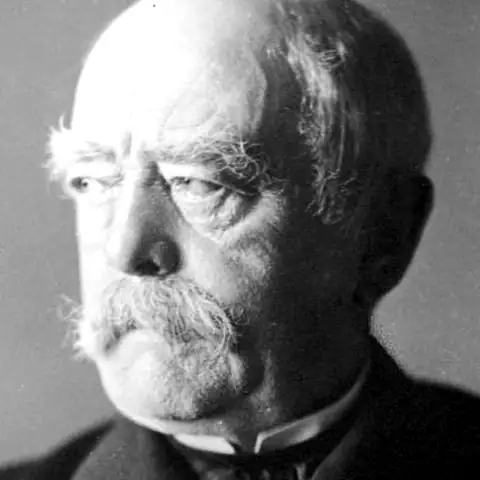
Otto von Bismarck
Historical figureGermany1815-1898

Otto von Bismarck

Minister-President of Prussia · First Chancellor of the German Empire (1871-1890)

Prussian statesman who united Germany after three wars and became its first chancellor. A conservative royalist, he fought Catholic and socialist movements yet also set up the first state insurance for workers.

Profile on 12 axes11 of 12 documented
ECONOMYSTATESOCIETYWORLDOwnershipMarketsWelfareAuthoritySecurityStructureMoralityReligionTechnologyCultureTradeForeign
Where they stood

Otto von Bismarck, axis by axis

  1. PublicPrivate
  2. PlannedFree
  3. SharedSelf-reliant

    He launched some of the earliest state insurance schemes, but frankly as a tool to weaken Social Democracy. The score is therefore moderate.

  4. DemocraticStrong leader
  5. LibertyOrder
  6. LocalCentral

    The empire joined together many monarchies, yet Prussia dominated them. This makes the score mildly centralizing.

  7. ProgressiveTraditional
  8. SecularReligious

    A committed Protestant, he nonetheless took on the Catholic Church in the Kulturkampf, so the score sits near neutral.

  9. 09TechnologyNo clear record
    EmbraceCaution

    No view of his is recorded on technology debates like today's ones. This was the 19th century.

  10. MulticulturalNational identity
  11. GlobalProtected
  12. CooperationStrength

    He used war to unite Germany from 1864 to 1871. Afterwards he built defensive alliances and acted as a go-between at the Berlin congress of 1878.

One axis has no clear record, so matching leaves it out.

Who was Otto von Bismarck?

Otto von Bismarck came from the Prussian landowning class and worked as a diplomat. He became Prussia's minister-president in 1862 and in 1871 the first chancellor of the German Empire. People called him the Iron Chancellor. He brought the German states together under Prussian leadership after wars against Denmark, Austria and France. At home he guarded the king's power against liberal parliamentarians, fought the Catholic Centre Party and the socialists, and set up the first national insurance system for workers. Kaiser Wilhelm II forced him out in 1890.

Political views

  • Speaking in 1862, he held that the great issues would be settled by 'iron and blood' and not by speeches and majority votes.Source: bismarck-stiftung.de
  • Through the 1870s he led the Kulturkampf, a struggle with the Catholic Church and its Centre Party in which the Liberals sided with him.Source: dhm.de
  • He then let that struggle end, split from the Liberals and began working with the same Catholic party.Source: en.wikipedia.org
  • He supported a law of 1878 that banned Social Democratic groups and their newspapers.Source: en.wikipedia.org
  • He brought in insurance for health in 1883, accidents in 1884, and old age and disability in 1889, partly to draw workers away from socialism.Source: dhm.de
  • In 1879 he dropped free trade and chose tariffs to protect industry and farming, which broke his ties with the National Liberals.Source: dhm.de
  • He supported efforts to Germanize the Polish-speaking provinces of Prussia.Source: en.wikipedia.org
  • Once the empire existed he described Germany as a satisfied power. He then used alliances, and the Berlin congress of 1878, to keep Europe in balance.Source: bismarck-stiftung.de

Legacy

Admirers say he built a united Germany, kept Europe's great powers at peace for around two decades from 1871, and set the foundations for the modern welfare state. Some historians add that he never shed the authoritarian outlook of the Junker landowners he came from. Critics focus on the pressure he put on Catholics, socialists and Poles, and on a constitution that kept parliament weak. Many historians think this weakness made it harder for democracy to take root in Germany later.

In their own words

“Not by speeches and majority decisions are the great questions of the day decided - that was the great mistake of 1848 and 1849 - but by iron and blood.”
Speech to the budget committee of the Prussian Landtag, 30 September 1862 (translated from German)

How close are you to Otto von Bismarck?

Take the 12 Axes test and see which historical figure is your political twin, axis by axis.

Take the test

Otto von Bismarck: questions

Was Bismarck a conservative?

Yes. He was a Prussian royalist who stood for order and the crown. He led no party of his own. His majorities kept changing, starting with the National Liberals and moving later to the conservatives and the Centre Party.

Did Bismarck create the welfare state?

He created its early form. His laws on health, accident and old-age insurance were the first of their kind on a national scale. He also meant them to win workers away from the socialists.

Why was Bismarck called the Iron Chancellor?

It comes from his 1862 speech on 'iron and blood' and from the way he used war and tough executive rule to bring Germany together.

Sources