12axes-testTake the test
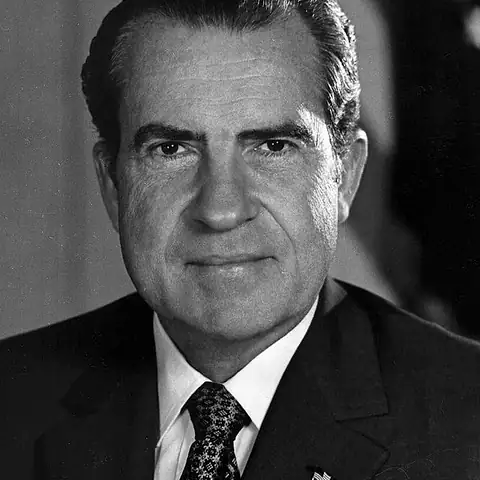
Richard Nixon
Historical figureUnited States1913-1994

Richard Nixon

37th President of the United States (1969-1974) · 36th Vice President of the United States

Nixon was a Republican president who opened ties with China, eased tensions with the Soviets and created the EPA. He is the only president ever to resign, because of Watergate.

Profile on 12 axesAll 12 documented
ECONOMYSTATESOCIETYWORLDOwnershipMarketsWelfareAuthoritySecurityStructureMoralityReligionTechnologyCultureTradeForeign
Where they stood

Richard Nixon, axis by axis

  1. PublicPrivate
  2. PlannedFree

    He was a Republican, yet he imposed wage and price controls in 1971 and widened federal rules on the environment and workplaces.

  3. SharedSelf-reliant
  4. DemocraticStrong leader

    The score reflects the abuses of power and secret actions behind Watergate that ended his presidency, although most of his policy went through normal legislative channels.

  5. LibertyOrder
  6. LocalCentral
  7. ProgressiveTraditional
  8. SecularReligious
  9. EmbraceCaution

    His record is mixed. He created the EPA and tightened emissions rules, and he also supported federal science programs.

  10. MulticulturalNational identity
  11. GlobalProtected

    His 1971 economic package, including the end of the gold link, broke with free-market orthodoxy. Otherwise his trade views were close to the Republican mainstream.

  12. CooperationStrength

    He practiced realpolitik. He pursued detente with the Soviets and opened relations with China, but he also ordered secret bombing in Cambodia and worked against Allende's government in Chile.

Who was Richard Nixon?

Richard Nixon was born in 1913 and came from California. He first became known as a tough anticommunist in the House, then went on to the Senate and served as Dwight Eisenhower's vice president. He lost the 1960 race to John F. Kennedy, but won the presidency in 1968 and was re-elected by a landslide in 1972. He spoke for a 'silent majority' and promised law and order, yet at home he governed pragmatically and widened federal rules on the environment and workplaces. With Henry Kissinger he worked to ease the Cold War. The Watergate scandal forced him to resign in August 1974, and he died in 1994.

Political views

  • He sought better ties with the Soviet Union and set up relations with the People's Republic of China.Source: millercenter.org
  • He signed the law that created the Occupational Safety and Health Administration, and in 1970 he proposed the Environmental Protection Agency.Source: millercenter.org
  • He signed Clean Air Act changes that forced cuts in car pollution and set up national air-quality testing.Source: millercenter.org
  • In 1971 he froze wages and prices and temporarily closed the gold window to deal with inflation and pressure on the dollar.Source: millercenter.org
  • He put forward a Family Assistance Plan to reform welfare and reward work. Congress never passed it.Source: millercenter.org
  • His Vietnamization policy handed ground fighting to South Vietnamese troops, while the US secretly bombed supply routes in Cambodia.Source: millercenter.org

Legacy

Admirers point to the opening to China, arms control with Moscow, the end of American ground combat in Vietnam and domestic steps like the EPA. Some scholars find his domestic record milder than his speeches. Critics stress the Watergate cover-up, the secret spread of the war into Cambodia, his hostility to Chile's elected government and election tactics they say played on racial and cultural splits. With impeachment likely, he resigned in 1974, and Gerald Ford pardoned him. In later years he wrote about world affairs and won back some of his reputation.

In their own words

“North Vietnam cannot defeat or humiliate the United States. Only Americans can do that.”
Address to the Nation on the War in Vietnam (Silent Majority speech), 1969

How close are you to Richard Nixon?

Take the 12 Axes test and see which historical figure is your political twin, axis by axis.

Take the test

Richard Nixon: questions

Was Richard Nixon a conservative?

He campaigned as one on crime and anticommunism. In office, though, he created the EPA and OSHA and imposed price controls, steps many conservatives disliked. Historians often call him a pragmatist.

Why did Nixon resign the presidency?

He quit in August 1974 because of Watergate. The scandal began with a break-in at Democratic offices, and his aides then tried to cover it up. He faced almost certain impeachment in the House.

What did Nixon achieve in foreign policy?

He opened relations with China, signed arms control deals with the Soviet Union and ended US ground combat in Vietnam. Critics add that he widened the war into Cambodia in secret.

Sources