12axes-testTake the test
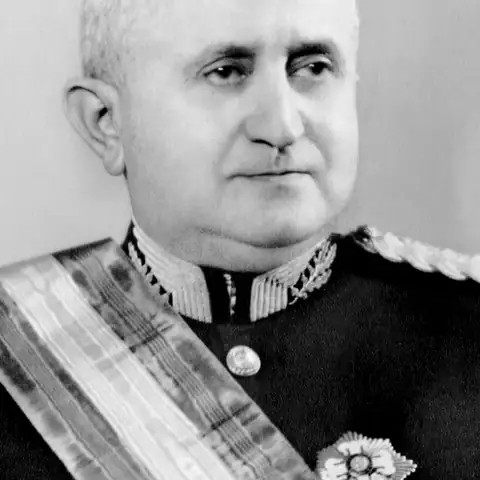
Eurico Gaspar Dutra
Historical figureBrazil1883-1974

Eurico Gaspar Dutra

President of Brazil (1946-1951) · Minister of War (1936-1945)

Brazilian army marshal who served Vargas's dictatorship as war minister, then won the 1945 election, restored a constitution, outlawed the Communist Party and sided with the United States.

Profile on 12 axes10 of 12 documented
ECONOMYSTATESOCIETYWORLDOwnershipMarketsWelfareAuthoritySecurityStructureMoralityReligionTechnologyCultureTradeForeign
Where they stood

Eurico Gaspar Dutra, axis by axis

  1. PublicPrivate
  2. PlannedFree

    At first he freed imports and the exchange rate. Then he switched to import licenses and the SALTE spending plan once reserves ran low.

  3. SharedSelf-reliant
  4. DemocraticStrong leader

    The voters chose him in 1945 and he ruled by the 1946 Constitution. Even so, he had propped up Vargas's regime from the war ministry, and in office he outlawed the Communist Party and meddled with unions.

  5. LibertyOrder
  6. LocalCentral
  7. ProgressiveTraditional
  8. SecularReligious

    Many tied his casino ban to Catholic moral campaigns, but he did not try to give the Church a formal place in law.

  9. 09TechnologyNo clear record
    EmbraceCaution

    No known stance on technology policy.

  10. 10CultureNo clear record
    MulticulturalNational identity
  11. GlobalProtected
  12. CooperationStrength

    He leaned toward Washington and broke off relations with Moscow in 1947. He also signed the Rio Treaty on shared defense, so no strong score is given.

2 axes have no clear record, so matching leaves them out.

Who was Eurico Gaspar Dutra?

Dutra came from Cuiabá, in Mato Grosso, and made his life in the Brazilian army. He helped crush a communist revolt in 1935. As war minister from 1936 he supported the 1937 coup that gave Getúlio Vargas his Estado Novo regime. In 1945 officers forced Vargas out, and Dutra won the presidency that December for the Social Democratic Party, with a late nod from Vargas himself. Under the 1946 Constitution elections, state powers and civil rights came back. At the same time, as the Cold War set in, he cracked down on the left and on trade unions. He died in Rio in 1974.

Political views

  • His term ran under the 1946 Constitution. It brought back an elected Congress, self-rule for the states and personal freedoms that the dictatorship had ended.Source: planalto.gov.br
  • He backed the 1947 court ruling that struck the Brazilian Communist Party off the register, and police then shut its offices.Source: www18.fgv.br
  • In 1946 he limited strikes by decree, and his labor ministry cancelled union elections and took over unions.Source: www18.fgv.br
  • In April 1946 he outlawed gambling and ordered every casino shut.Source: www18.fgv.br
  • The minimum wage stayed at its 1943 level for his whole term, while living costs went up by about 60 percent.Source: www18.fgv.br
  • He won approval for SALTE, a state investment plan covering health, food, transport and energy.Source: planalto.gov.br

Legacy

Many Brazilians remember Dutra as a careful, rule-bound president who led the country back to constitutional government after the Estado Novo. Supporters say he kept to the 1946 charter, running regular elections and handing the office to the winner of the next vote, even though that winner was Vargas. Critics recall that he had once been one of the main army backers of the 1937 dictatorship. They add that he outlawed the Communist Party, removed its elected lawmakers, cut ties with the USSR and put down strikes and free unions. Economists say he spent the wartime foreign reserves too fast by opening imports early. His 1946 casino ban lasted for decades and still comes up whenever Brazil debates legal gambling.

How close are you to Eurico Gaspar Dutra?

Take the 12 Axes test and see which historical figure is your political twin, axis by axis.

Take the test

Eurico Gaspar Dutra: questions

Which party did Eurico Gaspar Dutra belong to?

He ran in 1945 for the Social Democratic Party (PSD). Late in the race he also gained the backing of Vargas and of the Brazilian Labor Party (PTB).

Why are casinos illegal in Brazil?

A decree Dutra issued in April 1946 banned games of chance and closed all casinos. People at the time tied the move to Catholic moral campaigns. The ban lasted for decades.

Was Dutra a dictator?

No. Voters elected him and he governed by the 1946 Constitution. Before that, though, he was a key backer of the dictatorship Vargas ran as the Estado Novo.

Sources