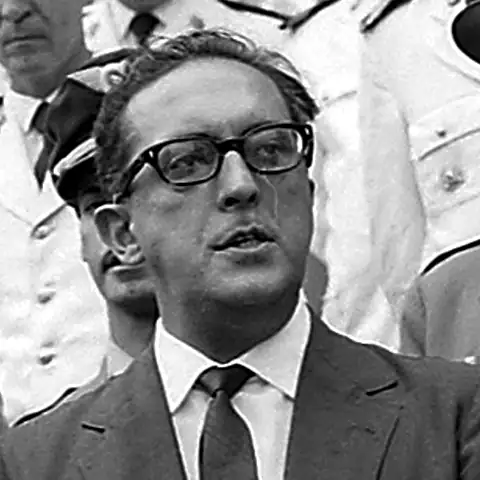
Who was Carlos Lacerda?
Carlos Lacerda came from a political family in Rio de Janeiro, where he was born in 1914. As a young man he moved in communist circles, then broke with them in the late 1930s and became a Catholic in the 1940s. His paper, Tribuna da Imprensa, launched in 1949, made him the loudest voice against Getúlio Vargas. In 1954 a gunman attacked him on Rua Tonelero and killed an air force major who was guarding him. The crisis ended with Vargas taking his own life. Lacerda won the new governorship of Guanabara in 1960. After backing the 1964 coup he clashed with the military rulers, and they stripped his political rights in December 1968.
Political views
- Said in 1950 that Vargas should be barred from standing, winning, taking office or ruling.Source: www18.fgv.br
- Argued in 1955 for putting off the presidential vote, closing Congress and letting foreign private money into oil exploration.Source: www18.fgv.br
- As governor, built hundreds of new primary schools and made primary schooling compulsory in his state.Source: www18.fgv.br
- Ran a scheme that cleared favelas and moved the families to new housing estates, often over their objections.Source: www18.fgv.br
- Welcomed the ousting of João Goulart in 1964 and described it as a shield against communism.Source: www18.fgv.br
- Started the Frente Ampla in 1966 with old enemies, calling for civilian rule and direct elections.Source: www18.fgv.br
Legacy
Lacerda is still one of the most divisive names in Brazil's 1946-1964 republic. Supporters remember a gifted speaker and writer, a committed anticommunist and a capable governor whose team put up hundreds of schools, a big new water main and sewer lines. Critics say that his repeated calls to keep elected leaders out of power wore down democratic habits and paved the way for 1964, and that the favela removals tore apart poor communities. His late partnership with Kubitschek and Goulart against the generals looks to some like a real change of heart. Others see a man reacting to his own blocked ambitions.
In their own words
“Mr. Getúlio Vargas, senator, must not be a candidate for the presidency. A candidate, he must not be elected. Elected, he must not take office. Once in office, we must resort to revolution to prevent him from governing.”