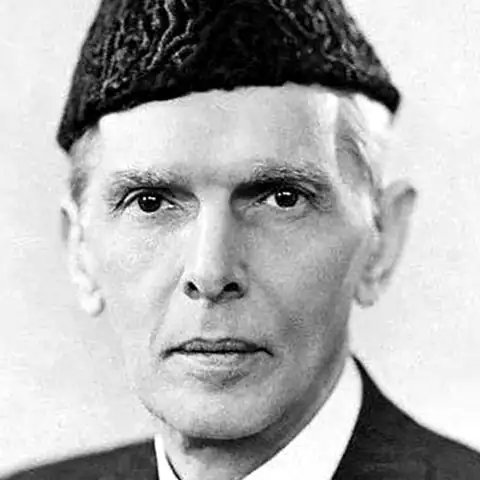
Who was Muhammad Ali Jinnah?
Jinnah was born in Karachi in 1876 and trained as a barrister in Britain. He joined the Indian National Congress in 1906 and left it in 1920. He then led the Muslim League, first seeking equal political rights for Indian Muslims and an agreement with Hindus. At Lahore in 1940 he proposed partitioning India and creating Pakistan where Muslims were a majority. Pakistan became independent on 14 August 1947, and Jinnah was sworn in as its first governor-general the next day. He also became president of its constituent assembly. He died of tuberculosis near Karachi on 11 September 1948.
Political views
- He joined the Indian National Congress in 1906 and left in 1920, after which he led the Muslim League's campaign for political equality for Indian Muslims.Source: encyclopedia.com
- By 1940 he had adopted the aim of a separate Muslim state. At Lahore that year he proposed partition and a Pakistan in Muslim-majority areas.Source: biography.com
- On 11 August 1947 he told Pakistan's constituent assembly that people were free to worship as they chose and that faith had nothing to do with the business of the state.Source: pakistani.org
- In the same speech he said all citizens should be equal whatever their community, and he expected religious identity to matter less in public life over time.Source: pakistani.org
- He called keeping law and order the government's first duty, protecting the life, property and religious beliefs of its citizens.Source: pakistani.org
- He called bribery and corruption a poison and said the assembly should stamp them out firmly.Source: pakistani.org
- He called black marketing a grave crime against society and urged severe punishment for offenders rather than light fines.Source: pakistani.org
- He urged people to move past regional, sectarian and caste divisions such as Pathan, Punjabi, Shia, Sunni and Bengali.Source: pakistani.org
Legacy
Pakistanis revere Jinnah as the Quaid-e-Azam, or great leader, who won a homeland for South Asian Muslims through constitutional politics. Admirers point to his 1947 call for equal citizenship as a vision of an inclusive state. Critics note that the partition he demanded was followed by mass violence and displacement. They also say his Muslim nation idea deepened the communal divide, and that Pakistan's later rulers have claimed his words for both secular and religious states. One account notes that as governor-general he dismissed an elected provincial government. Historians still argue over what kind of state he meant to build.