12axes-testTake the test
Ludwig Erhard
Historical figureGermany1897-1977

Ludwig Erhard

Chancellor of the Federal Republic of Germany (1963-1966) · Federal Minister of Economics (1949-1963)

Economist and Christian Democrat who scrapped price controls in 1948, championed the social market economy and led West Germany as chancellor in the mid-1960s.

Profile on 12 axes11 of 12 documented
ECONOMYSTATESOCIETYWORLDOwnershipMarketsWelfareAuthoritySecurityStructureMoralityReligionTechnologyCultureTradeForeign
Where they stood

Ludwig Erhard, axis by axis

  1. PublicPrivate
  2. PlannedFree

    He believed in free prices and competition but also wanted anti-cartel law to prevent monopoly, so he is not scored as a pure laissez-faire figure.

  3. SharedSelf-reliant

    For him the market was already social, so he backed only a bare minimum of welfare law, even though the CDU cabinets he sat in raised pensions.

  4. DemocraticStrong leader
  5. LibertyOrder
  6. LocalCentral
  7. ProgressiveTraditional

    He said little in public on family or sexual morality, so this score comes from the general conservatism of his party.

  8. SecularReligious
  9. 09TechnologyNo clear record
    EmbraceCaution

    His views on technology as a values question are not documented, so there is no score here.

  10. MulticulturalNational identity
  11. GlobalProtected
  12. CooperationStrength

One axis has no clear record, so matching leaves it out.

Who was Ludwig Erhard?

Ludwig Erhard grew up in Fürth and became an economist. He kept out of the Nazi party. Once the war ended, he served as economics minister of Bavaria and then ran economic affairs in the Western occupation zones. In June 1948, the same month a new currency was launched, he lifted rationing and freed most prices. When the Federal Republic was formed he became economics minister, a job he kept until 1963, and the booming economy made him a national figure. He added the title of vice chancellor in 1957. After Konrad Adenauer retired in 1963, Erhard became chancellor. His coalition collapsed over the budget, and he resigned in 1966.

Political views

  • Scrapped rationing and most price controls in 1948 on the grounds that prices set by the market, not by administrators, should direct goods to buyers.Source: hdg.de
  • Wanted private initiative to lead the rebuilding, limited by rules to prevent monopolies, cartels and too much economic power in a few hands.Source: encyclopedia.com
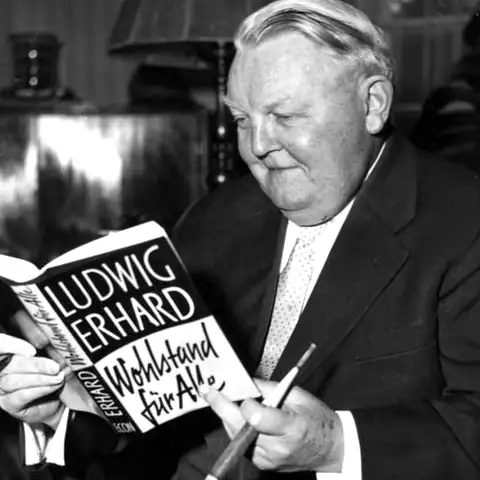
  • Named general prosperity as the purpose of economic policy, and gave that title to his 1957 book.Source: bundeskanzler.de
  • Thought the market already did social work, and so supported only a minimum of welfare legislation.Source: en.wikipedia.org
  • In the chancellery he put close ties with the US and Israel first, and he opened trade offices in a number of Eastern Bloc countries.Source: bundeskanzler.de
  • Chose to cut the budget when West Germany hit its first postwar downturn in 1966.Source: hdg.de
  • Held his course in 1948 through protests and strikes, and survived an SPD motion of no confidence in the Bizone's Economic Council.Source: hdg.de
  • Took over as chancellor in 1963 with a promise of moderation and understanding.Source: hdg.de

Legacy

Many call Erhard the architect behind West Germany's economic miracle, and market-liberal economists and the foundation named for him still hold him up as an example. His model became official CDU policy in 1949, and Germany's government says that for years he was the most loved politician in the country. His critics point out that he once worked at a consumer research institute that served the Nazi state. They add that his competition law was weakened by deals in 1957. Most historians rate him lower as chancellor than as economics minister.

How close are you to Ludwig Erhard?

Take the 12 Axes test and see which historical figure is your political twin, axis by axis.

Take the test

Ludwig Erhard: questions

Was Ludwig Erhard a liberal or a conservative?

He belonged to the Christian Democrats, the conservative camp in Germany. In economics, though, he was a market liberal who trusted competition and free prices, together with rules against monopolies.

What was the social market economy?

It was the West German model that Erhard promoted. Private firms and competition drive the economy, while the state sets rules so that markets stay fair. He argued that a well-run market already served social aims.

Why did Erhard leave the chancellery?

West Germany faced its first postwar downturn in 1966. A dispute over the budget broke up his coalition, and he resigned that year.

Sources

Portrait: Bundesarchiv B 145 Bild-F004204-0003, Ludwig Erhard mit seinem Buch.jpg by Adrian, Doris, CC BY-SA 3.0 de, via Wikimedia Commons. Cropped and converted to grayscale by 12axes-test.com.