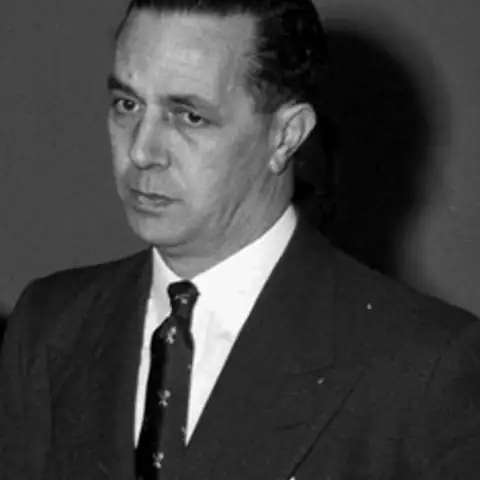
Who was Keith Joseph?
Keith Joseph grew up in a wealthy Jewish family in London. His father built the Bovis construction firm and became Lord Mayor. Joseph studied law at Oxford, fought in Italy as an artillery captain, and won a fellowship at All Souls. He became an MP in 1956. In Edward Heath's government he ran social services. After the defeats of 1974 he said he had never truly been a Conservative and began preaching free-market ideas. A speech at Edgbaston that October wrecked his chance at the leadership. He backed Thatcher, served in her cabinet until 1986 and was made a peer in 1987.
Political views
- Championed monetarism, took ideas from Milton Friedman and Friedrich Hayek, and brought Thatcher round to it.Source: theguardian.com
- Told a Stockton audience in 1976 that sound money alone would not do, and that the part of the economy that makes wealth must be allowed to grow.Source: margaretthatcher.org
- Was a founder of the Centre for Policy Studies in 1974, a body meant to develop free-market policy, and he popularised the social market economy idea.Source: en.wikipedia.org
- Spoke at Edgbaston in 1974 about a moral decline in Britain and asked for a renewal of the country's moral life.Source: margaretthatcher.org
- As Industry Secretary he got state industries ready for privatisation, yet he kept paying big subsidies to firms that lost money.Source: en.wikipedia.org
- At Education he joined O-levels and CSEs into one exam, the GCSE, and suggested parents help pay university fees, an idea he later dropped.Source: theguardian.com
Legacy
Fans call Joseph the mind behind Thatcherism. Thatcher said his Stockton lecture was one of only a few speeches that altered how a generation thought. The CPS gives an annual lecture in his name. His critics remember Edgbaston, where he warned that "our human stock is threatened" by births to poor mothers. Many found this offensive, and he said sorry for how he put it. Others argue his time in government was cautious compared with his speeches, and he thought his own ministerial record had failed.
In their own words
“Let me emphasise: to say that 'monetarism is not enough' is not in any sense to retreat from monetarism.”