12axes-testTake the test
Huey Long
Historical figureUnited States1893-1935

Huey Long

40th Governor of Louisiana (1928-1932) · U.S. Senator from Louisiana (1932-1935)

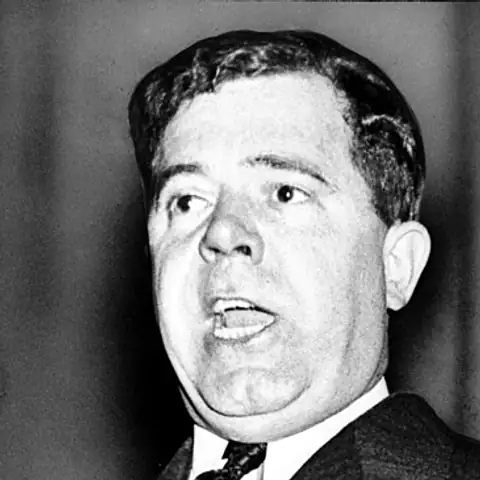
Louisiana governor and U.S. senator who paid for roads and schools, urged caps on big fortunes to guarantee every family an income, and kept tight personal control of his state.

Profile on 12 axes7 of 12 documented
ECONOMYSTATESOCIETYWORLDOwnershipMarketsWelfareAuthoritySecurityStructureMoralityReligionTechnologyCultureTradeForeign
Where they stood

Huey Long, axis by axis

  1. PublicPrivate

    Share Our Wealth set limits on private fortunes and incomes instead of taking industry into public hands, so the ownership score is only moderately public.

  2. PlannedFree
  3. SharedSelf-reliant
  4. DemocraticStrong leader

    He won big at the ballot box, but he controlled the Louisiana legislature and courts and removed rivals. Opponents said he behaved like a dictator.

  5. LibertyOrder

    He used National Guard soldiers to shut down illegal gambling and brothels in New Orleans.

  6. LocalCentral
  7. 07MoralityNo clear record
    ProgressiveTraditional
  8. 08ReligionNo clear record
    SecularReligious
  9. 09TechnologyNo clear record
    EmbraceCaution
  10. 10CultureNo clear record
    MulticulturalNational identity

    For a Southern politician his campaigns used little race-baiting, and his plan counted Black Americans in the income guarantee. He took no clear stand on immigration or national identity, so the axis is blank.

  11. 11TradeNo clear record
    GlobalProtected
  12. CooperationStrength

    He was an isolationist. He demanded quick independence for the Philippines and opposed joining the World Court.

5 axes have no clear record, so matching leaves them out.

Who was Huey Long?

Huey Long was born in 1893 and trained as a lawyer in Winnfield, Louisiana. He first won notice on the state railroad commission, then took the governorship in 1928 with a slogan about every man being a king while none wears a crown. His years as governor brought new roads, schools and public works, and he got through an impeachment fight in 1929. Voters sent him to the Senate in 1930. He backed Franklin Roosevelt at first, turned on him in 1933, and criticized the New Deal as too timid. A gunman shot him in the Louisiana State Capitol in September 1935, when many expected him to run for president. He died two days later.

Political views

  • Through Share Our Wealth he wanted a cap on personal fortunes, with the money paid out as a minimum for households, old-age pensions and schooling.Source: voicesofdemocracy.umd.edu
  • He wanted every person over 60 to get $30 a month, along with shorter working hours.Source: 64parishes.org
  • He parted ways with Roosevelt in 1933. In his eyes the New Deal helped the poor too little and left the spread of wealth unchanged.Source: en.wikipedia.org
  • Paved highways in Louisiana grew from 331 miles to 2,301 while he governed, and children received free schoolbooks. School enrollment climbed 20 percent over the same years.Source: 64parishes.org
  • He went after oil firms, Standard Oil above all, with new taxes. He also ended the poll tax and gave homeowners a tax exemption.Source: voicesofdemocracy.umd.edu
  • He opposed American membership of the World Court, and he blamed Standard Oil and Wall Street for shaping U.S. policy in Latin America.Source: en.wikipedia.org

Legacy

Admirers recall what he gave one of the poorest states: bridges, highways, classrooms, free books and reading classes for adults. Many think the pull of his wealth-sharing clubs, which said they had 7.5 million members, helped push Roosevelt to create Social Security and the Works Progress Administration. Critics, Roosevelt included, saw a dangerous demagogue. Long stocked state agencies with loyalists, turned the courts and legislature on his enemies, and is said to have called himself the Constitution in Louisiana. Some at the time likened him to Hitler and Mussolini. The state also ran up debt, from $11 million when he took office to $150 million in 1935.

In their own words

“Every man a king, so there would be no such thing as a man or woman who did not have the necessities of life, who would not be dependent upon the whims and caprices and ipse dixit of the financial martyrs for a living.”
Every Man a King, national radio address, 1934

How close are you to Huey Long?

Take the 12 Axes test and see which historical figure is your political twin, axis by axis.

Take the test

Huey Long: questions

What was Huey Long's Share Our Wealth idea?

Long launched it in 1934. Very large fortunes and incomes would be capped, and the money used to give each family a basic minimum, pay for pensions in old age and fund schools. Its supporters' clubs said millions had joined.

Was Huey Long left or right?

He was on the economic left. He wanted to tax the rich and spread wealth to poor families, and he attacked Roosevelt for doing too little. But his hold on power in Louisiana was authoritarian, so he does not fit a simple label.

Was Huey Long a dictator?

He was elected, but he ran Louisiana's legislature, courts and jobs, and he forced rivals out. Critics called that dictatorial. Historians still argue over how to weigh it against his public works.

Sources