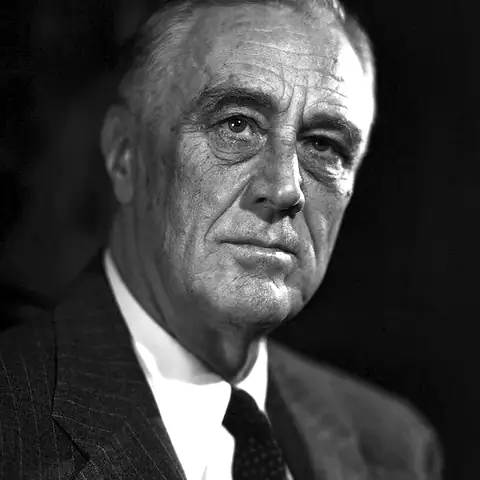
Who was Franklin D. Roosevelt?
Franklin Delano Roosevelt was a Democrat from New York who had served as governor of his state. Voters chose him as president in 1932, when the Great Depression was at its worst, and again in 1936, 1940 and 1944. He is the only person ever elected president four times. His New Deal brought in relief jobs, public works, rules for banks and markets, rights for unions and social insurance, and it greatly widened the federal government's part in the economy. After December 1941 he led the nation in World War II beside Britain and the Soviet Union. He died in April 1945, early in his fourth term.
Political views
- In 1935 he signed the Social Security Act, which set up federal old-age pensions and unemployment insurance.Source: millercenter.org
- He supported the Wagner Act, which guarded the right of workers to organize and set up the National Labor Relations Board.Source: millercenter.org
- He founded the Tennessee Valley Authority, a federal company that built dams and brought electric power to a very poor part of the South.Source: millercenter.org
- In 1934 he created the Securities and Exchange Commission to police financial markets.Source: millercenter.org
- After the Supreme Court struck down New Deal laws, he proposed in 1937 to add more justices. Congress refused.Source: millercenter.org
- In 1934 he won a law that let him lower tariffs by making deals with other countries one at a time.Source: millercenter.org
- He aided Britain through Lend-Lease, put his name to the Atlantic Charter and pushed for a United Nations after the war.Source: millercenter.org
Legacy
Admirers say Roosevelt restored trust during the Depression, built the modern American safety net and led the alliance that beat Nazi Germany and Imperial Japan. Many rank him among the best presidents. Critics, mostly conservatives and libertarians, say the New Deal pushed federal power past constitutional limits, slowed recovery and left lasting costs. His four terms led to the two-term limit that came later. Most people now see his government's removal of Japanese Americans from the West Coast in 1942 as a grave breach of civil liberties.
In their own words
“The only thing we have to fear is fear itself.”