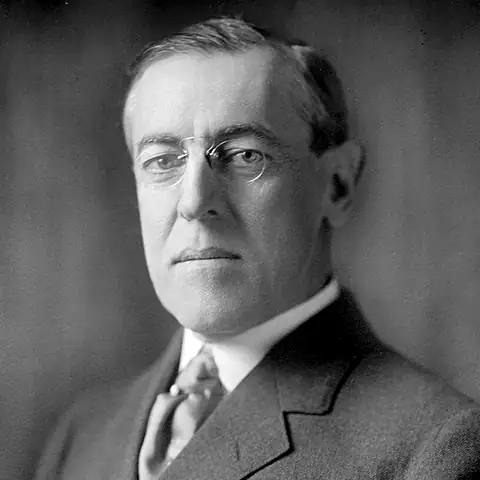
Who was Woodrow Wilson?
Before the White House, Woodrow Wilson was a political scientist, then the head of Princeton University and then governor of New Jersey. He became president in 1912 as a Democrat, helped by a Republican vote that was divided between William Howard Taft and Theodore Roosevelt. His New Freedom plan tried to bring back fair competition by cutting tariffs, reforming banks and curbing monopolies. He kept America out of World War I until 1917, when he asked Congress for a declaration of war on Germany. He then became the chief designer of the League of Nations, which the US Senate would not join. He was re-elected in 1916 and died in 1924.
Political views
- He drove through the Underwood-Simmons Act, which made the deepest tariff cuts since the Civil War and was paid for in part by a modest graduated income tax.Source: millercenter.org
- In 1913 he signed the Federal Reserve Act, which set up twelve regional reserve banks under a new national board.Source: millercenter.org
- He backed the 1914 Clayton Antitrust Act, and also a federal child labor law that the Supreme Court later overturned.Source: millercenter.org
- He let cabinet members bring racial segregation into federal offices, including the Post Office and the Treasury Department.Source: millercenter.org
- He backed the Espionage and Sedition Acts, which made it a crime in wartime to obstruct the draft or to criticize the government.Source: millercenter.org
- His Fourteen Points, with the idea of a league of nations, aimed to prevent new wars by joint security among states and by cutting arms.Source: millercenter.org
- He sent Marines into Haiti in 1915 and into the Dominican Republic a year later, and he used force in revolutionary Mexico.Source: millercenter.org
Legacy
Supporters say Wilson built a large part of the modern federal economic system, among them the Federal Reserve and the income tax. They also credit him with a liberal internationalism that shaped the United Nations and American foreign policy afterward. Critics on the left and the right alike point to curbs on speech in wartime and to the jailing of dissenters, among them the Socialist leader Eugene Debs. His government's segregation of federal workers has drawn sharp criticism, and institutions linked to his name have reviewed how they honor him. Realist scholars ask whether the results at Versailles matched his idealism.
In their own words
“The world must be made safe for democracy. Its peace must be planted upon the tested foundations of political liberty.”