12axes-testTake the test
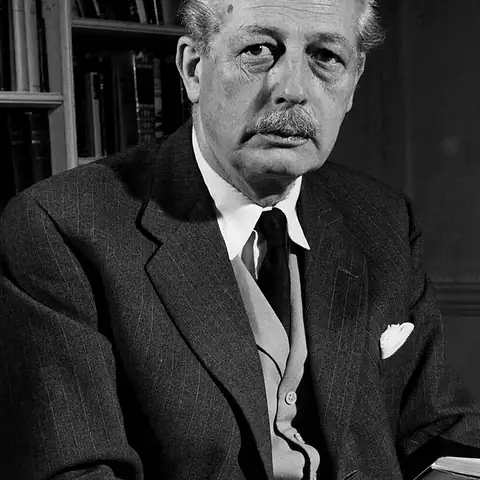
Harold Macmillan
Historical figureUnited Kingdom1894-1986

Harold Macmillan

Prime Minister of the United Kingdom (1957-1963) · Leader of the Conservative Party (1957-1963)

Tory leader in Downing Street for six years after Suez. He wanted a middle path between state and market, hurried colonies toward independence and tried to take Britain into the Common Market.

Profile on 12 axes11 of 12 documented
ECONOMYSTATESOCIETYWORLDOwnershipMarketsWelfareAuthoritySecurityStructureMoralityReligionTechnologyCultureTradeForeign
Where they stood

Harold Macmillan, axis by axis

  1. PublicPrivate
  2. PlannedFree

    His 1938 book argued for a centre-ground blend of planning and private business, and in office he promoted economic planning. The score leans slightly toward regulation.

  3. SharedSelf-reliant
  4. DemocraticStrong leader
  5. LibertyOrder
  6. LocalCentral
  7. ProgressiveTraditional
  8. SecularReligious
  9. 09TechnologyNo clear record
    EmbraceCaution

    No recorded view that bears on modern technology debates, so this axis is null.

  10. MulticulturalNational identity

    He sped up decolonisation and kept apart from apartheid, yet his government also passed the 1962 Commonwealth Immigrants Act, the first major curb on migration from the Commonwealth. The score is mixed.

  11. GlobalProtected

    He helped to found EFTA and then sought membership of the EEC. The score leans toward freer trade.

  12. CooperationStrength

    Britain held on to its own nuclear deterrent and kept close American ties under him, yet he also helped negotiate the 1963 test ban. The score sits near the middle.

One axis has no clear record, so matching leaves it out.

Who was Harold Macmillan?

Harold Macmillan came from a London publishing family and was badly hurt several times in the First World War. In the 1930s he sat for Stockton-on-Tees, saw heavy unemployment first hand, and wrote The Middle Way. From 1951 he held posts in housing, defence, foreign affairs and the Treasury. Suez brought him to Number 10 in January 1957, and in 1959 he increased his majority. Money troubles, a big cabinet purge in 1962 and the Profumo scandal marked his last years. He quit in October 1963 because of illness and died in 1986.

Political views

  • Set out a centrist creed in The Middle Way (1938), which joined private business with state planning.Source: en.wikipedia.org
  • Hit the goal of 300,000 new homes a year by 1953 while housing minister.Source: en.wikipedia.org
  • Was set on stopping a return to the mass unemployment of the 1930s, and told voters they had never had it so good.Source: gov.uk
  • Gave the 1960 wind of change speech, which signalled distance from apartheid and a faster end to colonial rule.Source: gov.uk
  • Mended ties with Washington after Suez and kept Britain's nuclear deterrent.Source: gov.uk
  • Sought Britain's entry to the European Economic Community, but France vetoed it in January 1963.Source: gov.uk
  • Took part in talks that produced the 1963 treaty banning most nuclear tests, signed with America and the Soviets.Source: gov.uk

Legacy

Admirers say Macmillan restored national confidence after Suez, oversaw growing prosperity, rebuilt the alliance with America and handled the retreat from empire with little fighting. Critics say his governments ignored deep weaknesses in the British economy and that by the early 1960s his manner seemed out of touch. His government was criticised over colonial emergencies, including the deaths of 11 detainees at the Hola camp in Kenya in 1959, and it was hurt further by the Profumo affair. In old age he attacked Margaret Thatcher's privatisations, which he is widely said to have compared to selling the family silver.

How close are you to Harold Macmillan?

Take the 12 Axes test and see which historical figure is your political twin, axis by axis.

Take the test

Harold Macmillan: questions

Was Harold Macmillan left or right?

He was a Conservative, but of the centre-ground kind. He wanted private enterprise alongside state planning and a welfare safety net, so his politics are often called one-nation Toryism.

What was the Middle Way?

It was Macmillan's 1938 book. Its argument was for a route that avoided both pure capitalism and socialism, blending private business with planning and social reform.

What did Macmillan mean by the wind of change?

In a 1960 speech he said that African national feeling was a fact Britain had to accept. It signalled that his government would speed up the end of colonial rule.

Sources