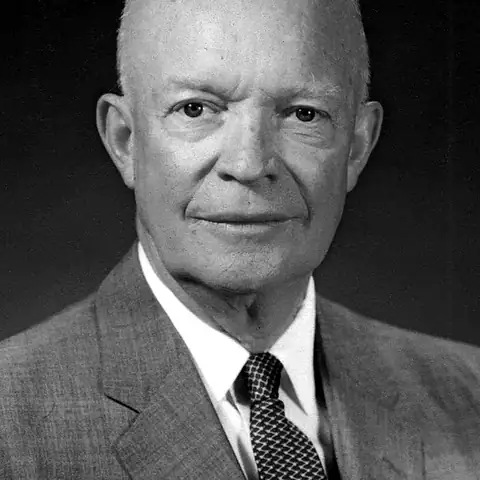
Who was Dwight D. Eisenhower?
Dwight Eisenhower was born in 1890 and spent his life as an Army officer. In World War II he led the Allied armies in Europe, and afterwards he headed Columbia University and became NATO's first military chief. He joined the Republicans in 1952 and won the White House that year, then won again in 1956. He called his approach Modern Republicanism. He wanted less spending and a smaller federal role than Harry Truman, but he did not undo Social Security or other New Deal programs. In foreign policy he aimed to contain the Soviet Union without letting military costs run wild. He died in 1969.
Political views
- Laws he signed widened Social Security and raised the minimum wage. He also created a new cabinet department for health, education and welfare.Source: millercenter.org
- His New Look defense policy leaned on nuclear weapons and secret CIA action to hold back communism more cheaply than large armies.Source: millercenter.org
- In 1956 he began the Interstate Highway program, a national network of about 41,000 miles of roads.Source: millercenter.org
- He okayed CIA operations that helped overthrow the Iranian government in 1953 and the Guatemalan one in 1954.Source: millercenter.org
- In 1957 Arkansas's governor called out the state guard to block black students from a Little Rock school. Eisenhower answered by sending federal troops to enforce integration.Source: millercenter.org
- His administration passed the first federal civil rights law since Reconstruction. He seldom spoke out in public to support the cause, however.Source: millercenter.org
Legacy
At the time, many saw Eisenhower as a calm figure who stayed above politics. Historians who later read his papers found a leader who worked actively behind the scenes, and his standing with scholars has grown. Supporters point to the end of the Korean War, the lack of direct war with the Soviets, tight defense budgets and the highway system. Critics say he said too little against segregation, was slow to challenge Senator Joseph McCarthy, and approved secret CIA operations whose long-term effects are still argued over. Both moderate Republicans and supporters of a restrained military point to his record.
In their own words
“In the councils of government, we must guard against the acquisition of unwarranted influence, whether sought or unsought, by the military-industrial complex.”