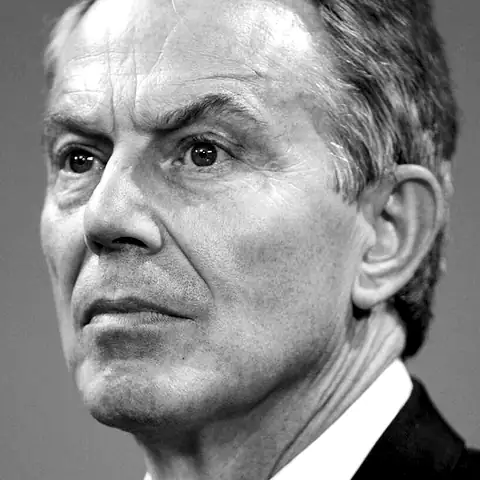
Who is Tony Blair?
Born in Edinburgh in 1953, Tony Blair studied law at Oxford and began work as a barrister. He won the Sedgefield seat in 1983, and when John Smith died in 1994 Labour made him its leader. Calling the party New Labour, he moved it to the centre ground and won big in 1997 and 2001, then again in 2005. Spending on health and education rose, and so did market-style reforms. When the September 2001 attacks happened, he stood alongside US President George W. Bush. He stepped down in 2007 and acted as the Quartet's envoy to the Middle East until 2015. He holds no elected office now, runs the Tony Blair Institute, and in 2026 took a seat on the executive board of the Board of Peace for Gaza.
Political views
- He won Labour over to rewriting Clause IV, so the party no longer pledged common ownership of industry.Source: en.wikipedia.org
- A national minimum wage arrived in 1998 under his government.Source: legislation.gov.uk
- Under him Scotland and Wales received devolved government, and the Human Rights Act, a Freedom of Information Act and reform of the House of Lords followed.Source: gov.uk
- He argued for liberal interventionism, the idea that outside powers may act to stop abuses, and backed force in Kosovo (1999) and Sierra Leone (2000).Source: gov.uk
- In March 2003 he went to the Commons and asked for approval to use force to disarm Iraq, citing weapons of mass destruction that were never found.Source: api.parliament.uk
- A 2004 law from his government let same-sex couples enter civil partnerships.Source: legislation.gov.uk
- Through his institute he argues that digital ID and artificial intelligence can help modernise the state.Source: thestack.technology
Legacy
Admirers point to three election wins and to the Good Friday Agreement. They also cite devolution, the minimum wage, big spending on public services and more LGBT rights. On the left, critics say he took on too much of Margaret Thatcher's legacy. Many others, from all sides, blame him for the 2003 invasion of Iraq. The Chilcot inquiry, reporting in 2016, found that the war case was put forward with too much certainty and that peaceful routes had not been used up. Civil liberties campaigners also disliked his counter-terrorism laws. What he has done since leaving office, from advising foreign governments to joining the Gaza Board of Peace in 2026, still brings praise and criticism.
In their own words
“This is a tough choice indeed, but it is also a stark one: to stand British troops down now and turn back, or to hold firm to the course that we have set. I believe passionately that we must hold firm to that course.”