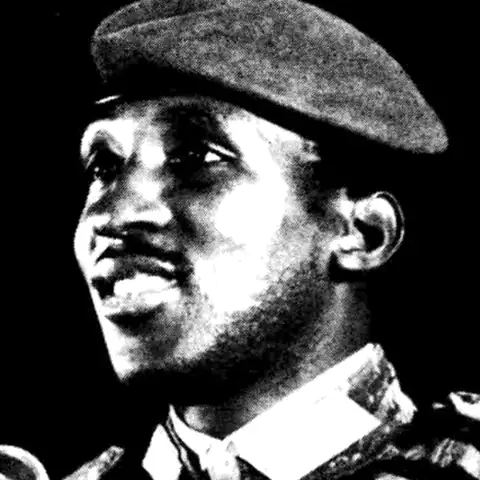
Who was Thomas Sankara?
Thomas Sankara was an army captain aged 33 when he came to power in 1983, in what he called a democratic and popular revolution. In 1984 he renamed Upper Volta as Burkina Faso, meaning land of the honest men. His government nationalized parts of the economy, built public housing, and banned female genital mutilation, polygamy and forced marriage. He criticized imperialism and colonial legacies, which angered Western leaders and won followers across Africa. On 15 October 1987 he and twelve colleagues were shot during a meeting of the ruling council, as his former comrade Blaise Compaoré took power.
Political views
- In his political orientation speech of 2 October 1983 he called the revolution democratic and popular, aimed at ending imperialist domination and social backwardness.Source: thomassankara.net
- He argued that after formal independence in 1960 colonial structures were kept alive through local elites, so neocolonial and colonial society were fundamentally alike.Source: thomassankara.net
- He described the Committees for the Defense of the Revolution as the local face of revolutionary power, called them assault detachments, and demanded that members avoid privilege and corruption.Source: thomassankara.net
- He called women's emancipation a fundamental necessity for the revolution and said real equality came through productive work and a voice in decisions.Source: thomassankara.net
- He wanted the army to take part in national production, such as building schools and clinics, and not stand as a separate caste.Source: thomassankara.net
- His speech set land reform, food self-sufficiency and equal trade among its goals, with non-aggression and non-interference in foreign relations.Source: thomassankara.net
- His government introduced nationalizations and public housing, and banned female genital mutilation, polygamy and forced marriage.Source: aljazeera.com
- He is quoted as saying there is no true social revolution without the liberation of women.Source: newint.org
Legacy
Admirers across Africa remember Sankara as an honest leader who fought corruption, put women's rights at the center of politics and challenged foreign domination, and some call him Africa's Che Guevara. Critics note that he held power through a military revolution, that his committees were designed to mobilize against opponents, and that he never faced a national vote. His killing in 1987 went unpunished for decades; after Compaoré fell in 2014, a trial of the accused was under way by 2022, with Compaoré, who is in exile, accused in absentia. Debates continue about how much was achieved in four years and how much was never tested.