12axes-testTake the test
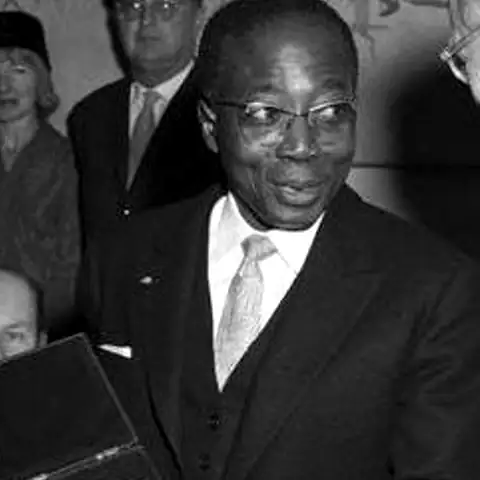
Léopold Sédar Senghor
Historical figureSN1906-2001

Léopold Sédar Senghor

First President of Senegal (1960-1980) · Poet and co-founder of négritude

Senegalese poet and co-founder of négritude who became the first president of independent Senegal, ran a state-led socialism with a single dominant party for years, and left office voluntarily.

Profile on 12 axes6 of 12 documented
ECONOMYSTATESOCIETYWORLDOwnershipMarketsWelfareAuthoritySecurityStructureMoralityReligionTechnologyCultureTradeForeign
Where they stood

Léopold Sédar Senghor, axis by axis

  1. PublicPrivate

    He backed a socialism with a major state role in the economy, though in practice it became pragmatic and technocratic. The score is moderate.

  2. PlannedFree
  3. 03WelfareNo clear record
    SharedSelf-reliant
  4. DemocraticStrong leader

    He banned every party except his own in the 1960s and then reopened competition in the 1970s, so the score sits between democratic and strong-leader.

  5. LibertyOrder
  6. LocalCentral
  7. 07MoralityNo clear record
    ProgressiveTraditional
  8. 08ReligionNo clear record
    SecularReligious
  9. 09TechnologyNo clear record
    EmbraceCaution
  10. 10CultureNo clear record
    MulticulturalNational identity
  11. 11TradeNo clear record
    GlobalProtected
  12. CooperationStrength

    He kept Senegal close to France and promoted exchange among African nations, and he worked for pan-African unity.

6 axes have no clear record, so matching leaves them out.

Who was Léopold Sédar Senghor?

Léopold Sédar Senghor was born on 9 October 1906 in Joal, Senegal. He studied in Paris, passed the agrégation in 1935 and taught in France. A prisoner of war in 1940, he joined the Resistance and was elected a deputy for Senegal in 1945. He served as a secretary of state in the French government in 1955 and 1956, and on 5 September 1960 became Senegal's first president. Re-elected four times, he stopped being president on 31 December 1980. He entered the Académie française in 1983 and died on 20 December 2001.

Political views

  • In 1930s Paris he developed négritude with Aimé Césaire and Léon Damas, affirming the value of black culture.Source: encyclopedia.com
  • His own version described African sensibility as intuitive rather than rational, a framing later critics called essentialist.Source: encyclopedia.com
  • His 1948 anthology of new black and Malagasy poetry in French, with a preface by Jean-Paul Sartre, is described as négritude's most significant poetic document.Source: treccani.it
  • He favored a moderate socialism and, in 1948, left the socialist party to found the Senegalese Democratic Bloc.Source: treccani.it
  • From 1962 he promoted what he called Senegalese socialism, with a major role for the state in the economy.Source: encyclopedia.com
  • He favored close ties with France, kept Senegal in the French community after independence and worked for African unity, including the Organization of African Unity in 1963.Source: encyclopedia.com
  • In the 1960s he declared all parties except his own illegal, then allowed competing parties again in the 1970s.Source: encyclopedia.com

Legacy

Admirers honor Senghor as a poet-statesman who gave black cultural pride a voice and as the first African head of government to hand over power peacefully. Several coup attempts against him failed. Critics charge that négritude, in his version, was essentialist and tacitly accepted European assumptions, and that he ruled as an increasingly authoritarian president in the 1960s, using patronage and a single party to silence critics. After Prime Minister Mamadou Dia, who favored a break with France, was accused of a coup attempt in 1962, Senghor crushed it and Dia was sentenced to life, though later freed. Growth stayed weak because of dependence on peanut exports.

How close are you to Léopold Sédar Senghor?

Take the 12 Axes test and see which historical figure is your political twin, axis by axis.

Take the test

Léopold Sédar Senghor: questions

What was négritude?

A cultural movement of the 1930s, developed in Paris by Senghor, Aimé Césaire and Léon Damas, that affirmed the value of black culture. Critics later called Senghor's version essentialist.

Was Senghor a socialist?

He called his program Senegalese socialism from 1962, with a large state role in the economy. It became increasingly pragmatic and technocratic over time.

Did Senghor rule as a dictator?

He allowed no rival parties through much of the 1960s and sidelined critics with patronage, but he reopened multiparty competition in the 1970s and left office voluntarily at the end of 1980.

Sources

Portrait: Léopold Sédar Senghor.jpg by Bundesarchiv_B_145_Bild-F011981-0003,_Frankfurt-Main,_Staatspräsident_von_Senegal.jpg : Steiner, Egon derivative work..., CC BY-SA 3.0, via Wikimedia Commons. Cropped and converted to grayscale by 12axes-test.com.