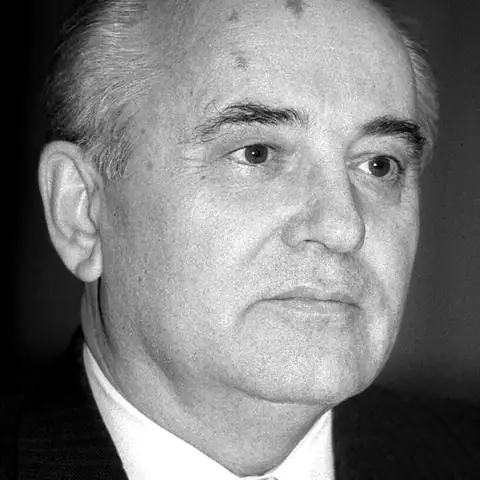
Who was Mikhail Gorbachev?
Mikhail Gorbachev came from a farming family in the south of Russia, in the Stavropol area. He studied law in Moscow and rose steadily in the Communist Party. By 1980 he was the Politburo's youngest full member, and in March 1985 he became its General Secretary. He set out to rebuild the economy through perestroika and to loosen the grip on public life through glasnost. A new parliament made him executive president in 1989. Hardliners tried to overthrow him in August 1991 and failed. He gave up the party leadership, and when the Soviet Union dissolved he resigned as president on 25 December 1991.
Political views
- In foreign affairs he promoted 'new thinking', which let each nation pick its own system and sought a fair balance between states.Source: nobelprize.org
- He agreed nuclear arms cuts with the United States and pulled Soviet troops out of Afghanistan.Source: nobelprize.org
- He did not send Soviet forces to put down the Eastern European revolutions of 1989, and he did not block German reunification.Source: nobelprize.org
- At home he argued for a mixed economy resting on new forms of property.Source: nobelprize.org
- He wanted the Soviet economy to join the world, with a convertible ruble and membership in international economic bodies.Source: nobelprize.org
- He pressed for more democracy and a new constitution that would turn the Union into a free and voluntary federation.Source: nobelprize.org
- He insisted that perestroika was not a copy of the West and that the USSR would find a road of its own.Source: nobelprize.org
Legacy
Many in the West, and many Soviet reformers, thank Gorbachev for ending the Cold War without a major war, for letting Eastern Europe decide its own future and for opening Soviet life to debate. Inside Russia many blame him for economic pain and for the breakup of the state, and polls there have often judged him harshly. Baltic and Caucasus peoples recall the force used against independence movements from 1989 to 1991. Meanwhile hardliners in his own party resisted his changes and tried the coup of August 1991.
In their own words
“Life is much richer and more complex than even the most perfect plans to make it better.”