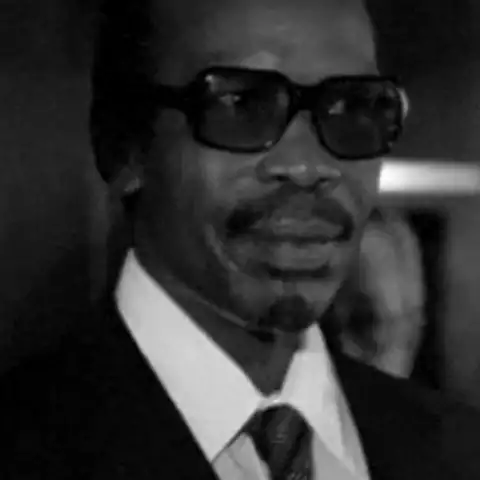
Who was Seretse Khama?
Seretse Khama was born on 1 July 1921 in Serowe in Bechuanaland and became chief of the Bangwato as a small child, with his uncle acting as regent. He studied at Fort Hare, at Balliol College, Oxford, and at the Inner Temple. His 1948 marriage to Ruth Williams, a white Englishwoman, set off a diplomatic dispute. Britain removed him as chief in 1950 and sent the couple into exile, and in 1956 they returned on condition that he gave up the chieftainship. He founded the Botswana Democratic Party in 1962, negotiated independence and served as the first president until his death on 13 July 1980.
Political views
- In 1948 he married Ruth Williams, a white Englishwoman. The marriage caused a diplomatic dispute with Britain and South Africa that lasted almost a decade.Source: innertemple.org.uk
- The Bangwato declared him chief in 1949, but Britain removed him in 1950 and exiled the couple to London. They returned in 1956 only after he renounced the chieftainship.Source: innertemple.org.uk
- He founded the Botswana Democratic Party in 1962, and it won the first elections with universal franchise in 1965.Source: thuto.org
- Some describe the resulting system as a paternalist democracy under one dominant party. He also used his authority to reduce the power of traditional chiefs and strengthen local democracy.Source: thuto.org
- He sought an export economy built on beef, copper and diamonds, and mineral revenue paid for infrastructure, education, health and cattle subsidies.Source: thuto.org
- His government set up a multiracial democracy and introduced universal education.Source: innertemple.org.uk
- He was one of the front-line presidents who negotiated the futures of Zimbabwe and Namibia, and he is described as a key founder of what became the Southern African Development Community.Source: thuto.org
- He argued that a nation without a past is a lost nation and urged Africans to write their own histories.Source: sahistory.org.za
Legacy
Admirers credit Khama with keeping Botswana peaceful, non-racial and democratic while neighbors suffered war and corruption, and with an economy that was described as the fastest growing in the world between 1966 and 1980. Critics note that one dominant party governed, which some call a paternalist democracy. They also point to the inequalities that appeared after his death, even though diamond and mineral wealth funded schools and clinics.