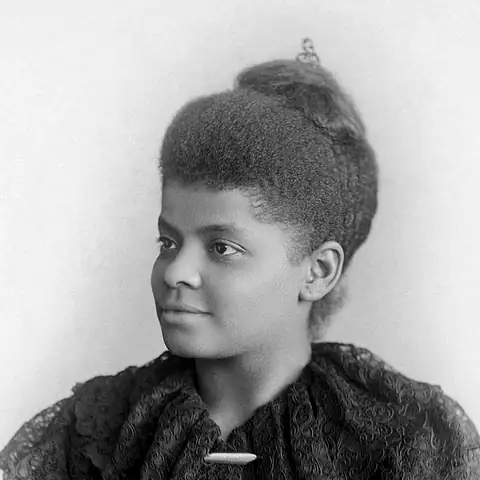
Who was Ida B. Wells?
Ida B. Wells was born into slavery in Holly Springs, Mississippi, in 1862. Orphaned at sixteen, she supported her siblings as a teacher and then became a Memphis newspaper editor. After the lynching of her friend Thomas Moss in 1892, a mob destroyed her newspaper office and she left the city. From the North she documented lynching in the pamphlets Southern Horrors and A Red Record and toured Britain. In Chicago she helped found women's clubs, the Alpha Suffrage Club and the Negro Fellowship League. She ran for the Illinois State Senate in 1930 and died in 1931.
Political views
- Argued that lynching was used to eliminate prosperous, politically active Black citizens and rejected the false rape charge offered as an excuse.Source: tennesseeencyclopedia.net
- After the 1892 Memphis lynchings, she armed herself and urged Black residents to leave the city.Source: tennesseeencyclopedia.net
- Met President William McKinley in 1898 to protest lynching and urge federal anti-lynching legislation.Source: tennesseeencyclopedia.net
- Toured Britain in 1893 and 1894, citing lynching accounts from the white Southern press and invoking British abolitionists to argue that outside moral pressure could change America.Source: blog.bham.ac.uk
- Believed that voting rights would help end lynching and that Black political power was essential.Source: tennesseeencyclopedia.net
- Founded the Alpha Suffrage Club and, at a 1913 suffrage parade, refused to march at the back with Black delegates.Source: womenshistory.org
- Insisted that women's rights include Black women and criticized Susan B. Anthony for not putting Black women's concerns first.Source: womenshistory.org
- Signed the call for the 1909 conference that led to the NAACP but later distanced herself from it, criticized Booker T. Washington and W. E. B. Du Bois, and praised Marcus Garvey.Source: tennesseeencyclopedia.net
Legacy
Admirers credit Wells with pioneering investigative reporting on racial violence, with gathering evidence and statistics that shamed officials, and with standing for Black women inside both the suffrage and civil rights movements. Lynching continued, and no federal anti-lynching law passed in her lifetime. Critics in her own day thought her too militant, and she was left off the NAACP's list of founders and drifted from its leaders. The U.S. Secret Service labeled her a radical. Her autobiography, published in 1970, brought her work wider recognition.